June 13, 2026
The Modern Birth Plan: Your Needs
Learn how to create a comprehensive, realistic birth plan that respects your unique preferences while ensuring the best outcomes for you and your baby.
Why I Still Believe in Birth Plans
I've been a doula long enough to hear every critique of the birth plan. "They never go as planned." "Doctors don't read them." "You're just setting yourself up for disappointment." And honestly? I get where those comments come from. Birth is unpredictable, and no piece of paper can control how labor unfolds.
But here's what I've seen in the delivery room over and over again: the families who walk in with a clear, well-organized birth plan are the ones who feel grounded when things shift—which they almost always do. The plan isn't about controlling the outcome. It's about knowing yourself well enough to make real-time decisions from a place of confidence rather than panic.
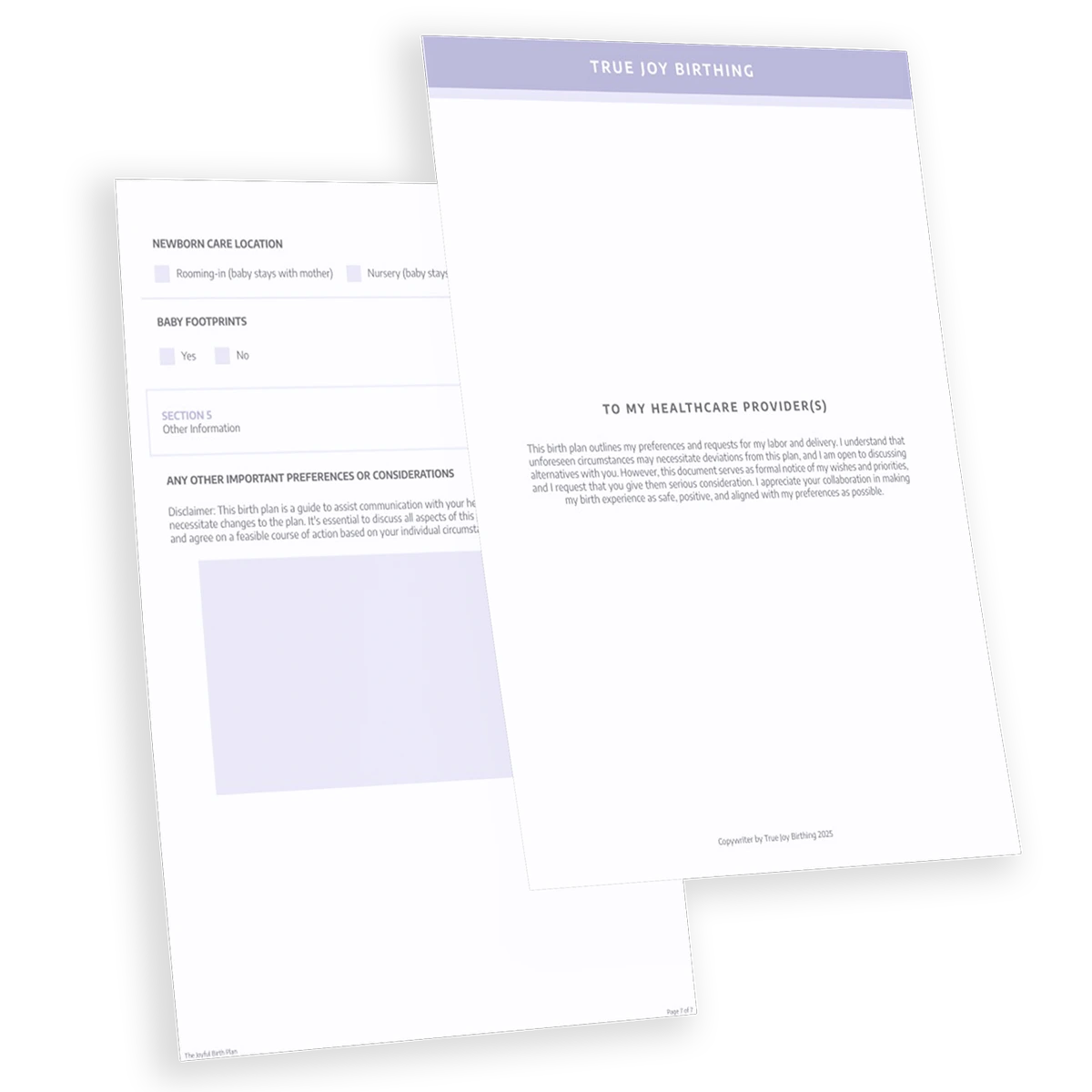
A modern birth plan is a communication tool. It tells your care team who you are, what you value, and how you want to be supported. That's not rigid—that's smart. If you're ready to start building yours, grab our free birth plan template and follow along.
The Shift Toward Natural Childbirth Preferences
More families than ever are choosing to labor without routine interventions. That doesn't mean refusing all medical support—it means wanting evidence-based care where interventions are used because they're needed, not because they're routine. The data backs this up: the American College of Nurse-Midwives reports that healthy, low-risk pregnancies have excellent outcomes with minimal intervention, and the World Health Organization has repeatedly emphasized that overmedicalization of normal birth leads to worse outcomes, not better ones.
When I sit down with clients, I hear the same thing over and over: "I want to feel like I was part of the decisions." Natural childbirth preferences aren't about ideology—they're about informed consent and bodily autonomy. You want to know why something is being recommended, what the alternatives are, and what happens if you wait. That's not controversial. That's standard of care.
If you're not sure what specific preferences to include, this guide on what to include in a birth plan walks you through every section.
What Makes a Birth Plan "Modern"
Old-school birth plans tended to be long, legalistic documents that read like contracts. They listed demands and expected compliance. Modern birth plans work differently. They're concise—one page, ideally—and they lead with values, not ultimatums.
Here's the structure I recommend:
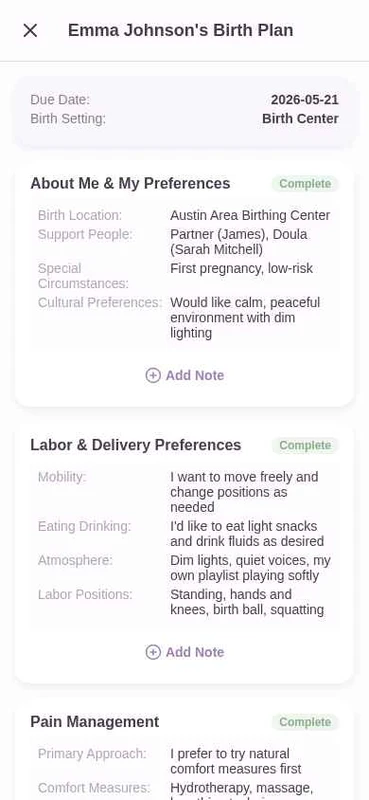
- A short introduction: Who you are, who your support people are, and a one-sentence summary of your overall approach (e.g., "We prefer to labor without routine interventions and would like time and alternative methods before any are considered.")
- Priority categories: Pain management, labor progression, monitoring, and postpartum care—grouped so your team can find information fast.
- Flexibility language: Phrases like "I prefer to try X first" rather than "I refuse Y." This opens conversation instead of shutting it down.
- A section for contingencies: What you'd want if transfer becomes necessary or if plans need to change mid-labor.
The modern approach recognizes that birth is dynamic. Your plan should reflect that. For a deeper dive into structuring a plan that works in a hospital setting, check out our hospital birth plan guide.
Core Preferences for Natural Childbirth
When you're building your plan around natural childbirth, these are the categories that matter most:
Labor environment. Dim lighting, freedom of movement, music or silence—whatever helps you feel safe and focused. Specify that you'd like to labor out of bed and change positions freely. Movement is one of your best tools for progressing labor and managing contractions.
Pain management. State your preference clearly: "I plan to use breathing techniques, movement, water, and position changes to cope with contractions. Please do not offer pain medication—I will ask if I want it." This keeps well-meaning nurses from suggesting an epidural at every shift change.
Monitoring. Intermittent auscultation with a Doppler is standard for low-risk labors and allows you to move freely. Continuous electronic monitoring restricts you to the bed and increases the likelihood of false-positive readings that lead to unnecessary interventions.
Labor augmentation. If labor slows, specify that you'd like natural methods first—position changes, walking, hydrotherapy, nipple stimulation—before synthetic oxytocin (Pitocin). If Pitocin becomes necessary, request that it start at a low dose and increase gradually.
Second stage and pushing. Request the option to push in positions other than lithotomy (on your back with legs in stirrups). Squatting, side-lying, and hands-and-knees all open the pelvis more effectively. Ask for coached pushing to be limited unless you specifically request it—you want to push when your body tells you to.
Immediate postpartum. Delayed cord clamping, immediate skin-to-skin, and keeping the baby with you for the first hour unless medically necessary. Specify that you'd like to breastfeed within the first hour if that's your goal.
Handling Pushback From Your Care Team
Let me be direct: some providers are not enthusiastic about natural birth plans. You may encounter eye rolls, dismissive comments, or pressure to "just see how it goes." Here's how I coach clients through that.
First, choose a provider whose practice aligns with your goals. A provider who delivers 95% of their patients with epidurals and routine Pitocin is not the right fit for an unmedicated birth—no matter how friendly they seem in the office. Ask specific questions at your prenatal visits: What's your cesarean rate? How often do your patients labor without an epidural? What percentage of your patients have their membranes ruptured artificially? Their answers tell you everything.
Second, have your doula present. I can't tell you how many times a simple "Let's give her a few more minutes—she's doing great" from a doula has changed the energy in the room. We're there to remind you of your preferences and help you ask questions when you're deep in labor land.
Third, use collaborative language. Instead of "I won't allow X," try "I'd prefer to try Y first, and I'd like to discuss it if X becomes necessary." Providers respond much better to partnership than to ultimatums—even when your preference is firm.
If you're in the Philadelphia area, I offer doula support in Philadelphia that includes birth plan review, provider communication coaching, and continuous labor support. And if you're closer to Pittsburgh, I can connect you with doulas in that region who share this approach.
When Plans Change—and They Will
I've attended births where everything went exactly as planned. I've also attended births where the plan went out the window at 4 centimeters. Both of those families felt prepared because they had done the work in advance.
Here's what I mean by "the work": knowing your preferences isn't the same as understanding the reasoning behind them. When you know why you want intermittent monitoring or delayed cord clamping, you can make informed decisions in real time. If a situation arises where continuous monitoring becomes necessary, you understand the medical reason, and you can consent from a place of knowledge rather than feeling like your plan was hijacked.
Build your contingency section with specific "if/then" scenarios:
- If labor stalls at 6 cm: I'd like to try walking, position changes, and rest before augmentation is discussed.
- If my water breaks before contractions start: I'd like up to 24 hours of monitoring before induction is considered, as long as there's no sign of infection. If an induction does become necessary, our induction birth plan template helps you adjust your preferences without starting over.
- If a cesarean becomes necessary: I'd like a clear explanation of why, and I'd like my partner and/or doula present in the OR if possible.
This kind of planning doesn't make you rigid—it makes you ready.
Involving Your Partner or Support Person
Your birth plan shouldn't just be yours on paper—it should be co-owned by anyone in the room with you. I sit down with couples and walk through every preference so that both partners understand the why behind each one. When your partner can advocate for you because they genuinely understand your wishes, you don't have to do the work of explaining during labor.
I recommend giving your partner a copy of the plan and having them practice saying things like, "She'd like to try position changes first," or "Can we have five minutes to discuss this before making a decision?" These aren't aggressive statements—they're collaborative, and they keep the conversation open.
Your partner should also know what comfort measures look like. Hip squeezes, counter-pressure, rebozo techniques—if they've practiced these before labor day, they'll feel useful instead of helpless. And that matters more than most people realize.
Making Your Birth Plan Work for You
The best birth plan is one that reflects your actual priorities, not someone else's checklist of what "should" matter. Take time to think through what you really care about. Is it freedom of movement? Avoiding an episiotomy? Having a calm, dim room? Keeping your baby with you after delivery? Write those things down first, then build the rest around them.
Keep it to one page. Use bullet points and white space. Hand copies to every nurse who comes on shift. Ask your provider to put it in your chart at a prenatal visit—then bring fresh copies on delivery day. The more accessible and readable your plan is, the more likely your team is to engage with it.
And remember: a birth plan is not a pass/fail test. If you end up needing interventions you hoped to avoid, that's not a failure. What matters is that you made informed choices every step of the way. The goal is not a specific outcome—the goal is feeling like you were an active participant in your own care.
If you're looking for more localized resources, our Pennsylvania doula hub connects families across the state with evidence-based birth support, childbirth education, and community.
I've watched hundreds of families walk through the birth plan process, and the ones who take it seriously—even imperfectly—consistently tell me they felt more in control, more respected, and more at peace with how their birth unfolded, regardless of the specifics. That's the real point of this exercise. Not perfection. Presence, preparation, and partnership.
Written by Shelbi Kohler