
Induction Birth Plan
Induction Birth Plan Template: What to Include and Copy-Paste Phrases

Shelbi Kohler, birth doula, 500+ families supported
Being induced changes your timeline, your options, and how your labor feels. A birth plan for induction needs to account for Pitocin, continuous monitoring, and a longer timeline. This free induction birth plan template covers monitoring, pain management, eating, and what to pack, with copy-paste phrases you can drop into your plan right now — so you walk into your induction with your preferences written down and your voice heard.
On this page
- Why Induction Needs Its Own Plan
- What Is a Birth Plan for Induction?
- Common Induction Methods
- Understanding Your Bishop Score
- Pain Management Timeline
- Typical Induction Timeline
- What to Pack for an Induction
- Monitoring Preferences
- Eating During Induction
- Questions to Ask at Your Scheduling Appointment
- What If Your Induction Does Not Work
- For Your Support Person
- Your Induction Birth Plan Template
- Birth Plan Language Tips
- Induction Birth Plan FAQ
Why Induction Needs Its Own Plan
An induction birth plan is not just a regular birth plan with "induction" written at the top. When your care team starts labor for you instead of waiting for your body to go into labor on its own, the experience is different in ways that matter for your plan. Writing a birth plan for induction that reflects those differences is what this template helps you do.
Here is what changes:
- A longer early phase. Pitocin contractions often ramp up differently than spontaneous labor. The early phase can feel longer or more intense than you expected, especially if your cervix is not yet ready.
- Continuous monitoring. Most hospitals require fetal monitoring throughout an induction. You can still move, but you will be tethered to monitors more than you would be during spontaneous labor.
- More interventions as the default. An IV, Pitocin, continuous monitoring, and restricted movement often come as a package deal with induction. Your birth plan should say which of these you consent to and which you would like to discuss.
- Your reasons matter. A 41-week post-dates induction feels different from a 37-week induction for preeclampsia. Your plan should include your context so every nurse who walks in understands your situation.
This does not mean induction is a bad experience. It means your birth plan needs to be more specific about what you want, because the default settings are more of everything. Your induction birth plan template should address each of these differences head on. The birth plan checklist helps you confirm you have covered everything.

What Is a Birth Plan for Induction?
A birth plan for induction is a written document that captures your preferences for a labor your provider starts medically rather than one your body begins on its own. It covers the same core topics as any birth plan, such as pain management, monitoring, and what happens after delivery, but it adds induction-specific sections like which method your provider will use, your Bishop score, and what you want if labor stalls.
The reason a birth plan for induction deserves its own document is that induction changes the defaults. You are more likely to have an IV, continuous fetal monitoring, restricted movement, and a longer timeline. Writing those realities into your plan means your nurse knows your preferences before the first dose of Pitocin, not after.
You do not need a separate template to get started. The induction birth plan template on this page is designed specifically for induced labor and includes every section you need, from cervical ripening preferences to a backup plan if the induction does not work.
Common Induction Methods
Knowing which method your provider plans to use helps you write a more specific induction birth plan. Each works differently:
- Pitocin (synthetic oxytocin). Given through an IV. Contractions start within about 30 minutes and are typically stronger and closer together than spontaneous contractions. Your nurse adjusts the dose throughout labor.
- Foley bulb. A small balloon catheter inserted into your cervix and inflated with saline. It physically opens the cervix without medication. Usually removed once you reach about 4 cm. Often used with Pitocin.
- Cytotec (misoprostol). A medication placed vaginally or taken orally to soften and ripen the cervix. Works over several hours. Cannot be used for VBAC patients due to rupture risk. If you are planning a VBAC birth plan, confirm your provider is not using Cytotec.
- AROM (artificial rupture of membranes). Your provider breaks your water using a small hook. This usually strengthens contractions but also commits you to delivering within a certain timeframe due to infection risk.
- Membrane sweep. Done during a prenatal visit. Your provider separates the amniotic sac from the cervix with a finger to stimulate natural labor. It is uncomfortable but does not require you to be in the hospital.
Ask your provider which method they plan to use and why. If your provider suggests multiple methods in sequence, your induction birth plan template should document that order so your nurse knows the plan before starting.
Understanding Your Bishop Score
Your Bishop score is a number from 0 to 10 that measures how ready your cervix is for labor. It is one of the most useful pieces of information you can have before filling out your induction birth plan template, because it helps set realistic expectations for how long your induction might take and which methods your provider will choose.
The score looks at five factors:
- Dilation, how open your cervix is (0 to 3+ cm)
- Effacement, how thin your cervix is (0 to 100%)
- Station, how low the baby's head is (-3 to +3)
- Consistency, how soft your cervix feels (firm to soft)
- Position, which direction your cervix faces (posterior to anterior)
A score of 8 or higher is considered favorable, meaning your body is already getting ready and induction is more likely to proceed smoothly. A lower score does not mean induction will fail, but it does mean your cervix may need ripening first (with Cytotec, a Foley bulb, or both) and the process may take longer.
Ask for your Bishop score at your scheduling appointment. Write it in your induction birth plan template so you have it handy when you arrive at the hospital. If your score is low and your provider is recommending induction, ask whether cervical ripening before Pitocin might give you a better experience.
Pain Management Timeline
Pitocin contractions feel different from spontaneous labor contractions. They often peak faster, feel more intense, and come with less break in between. That does not mean you cannot have an unmedicated induction. It means your induction birth plan needs to account for both possibilities.
If you want to try unmedicated labor, say so clearly. But also say what you want if labor becomes more than you expected:
Copy into your plan: "I'd like to try unmedicated labor for as long as I'm comfortable. If I request an epidural, I'd like it offered within 30 minutes. Please don't offer pain medication unless I ask."
If you know you want an epidural, state when:
Copy into your plan: "I plan to get an epidural when I'm around 4 to 5 cm dilated or when contractions become difficult to manage, whichever comes first."
Some providers recommend early epidural placement for induction patients in case a C-section becomes necessary. This is not a scare tactic, it is logistics. Knowing about it ahead of time helps you plan.
The key is flexibility language. Use phrases like "for as long as I'm comfortable" and "if I request" rather than rigid declarations. Induction has enough unpredictability already. Your pain management plan should bend without breaking.
Typical Induction Timeline
Every induction is different, but most follow a similar arc. Knowing the general timeline helps you prepare mentally and know when each part of your induction birth plan template becomes relevant.
- Arrival and intake (1 to 2 hours). You check in, get settled, have your IV placed, and your nurse confirms your Bishop score, baby's position, and the induction plan with your provider. This is a good time to share your birth plan.
- Cervical ripening (2 to 12 hours). If your Bishop score is low, you will likely start with Cytotec or a Foley bulb to soften and open your cervix before Pitocin. This phase can feel like waiting. You may be able to eat, walk around, and rest during this time.
- Pitocin start and titration (30 minutes to ramp up). Your nurse begins Pitocin at a low dose and gradually increases it until contractions are regular and strong. The dose is adjusted throughout labor based on your contraction pattern and how baby is tolerating it.
- Active labor (variable, typically 4 to 12 hours). Contractions intensify, your cervix dilates more quickly, and your pain management choices kick in. This is when your monitoring and movement preferences matter most.
- Pushing and delivery (30 minutes to 3 hours). Once you are fully dilated, you begin pushing. With an induction, you may have been laboring for many hours by this point, so your stamina and your support person's advocacy both matter.
Some inductions move quickly, start to finish in 6 to 8 hours. Others take 24 to 36 hours, especially with a low Bishop score. Your induction birth plan should account for a long day and the possibility that things change.
What to Pack for an Induction
Inductions take longer than spontaneous labors, often 12 to 24 hours or more. Pack like you are going on a very long, very important trip:
- Entertainment. A book, downloaded shows, podcasts, or a card game. The early phase can be hours of waiting before anything feels like active labor.
- Phone chargers and a long charging cable. You will be there a while and you will want your phone working.
- Snacks if your hospital allows them. Some hospitals allow light snacks during early induction. Others restrict food once Pitocin starts. Check the policy ahead of time and pack accordingly. Crackers, granola bars, and electrolyte drinks are common choices.
- Comfortable clothes. A robe, loose nursing tank, slip-on slippers, and your own pillow from home. Hospital beds and gowns get old after 18 hours.
- Items that make you feel human. Lip balm, face wipes, hair ties, lotion. Small comforts matter more when you are spending a full day in a hospital room.
If you are also preparing for a possible home birth plan or hospital birth, your packing list is shorter for those scenarios. For induction, plan for a longer stay.
Monitoring Preferences
Most hospitals require continuous fetal monitoring during Pitocin. This is standard protocol and your induction birth plan cannot override hospital policy. But you can ask for the most freedom within that policy.
Here are your options:
- Intermittent monitoring. Some hospitals allow monitoring every 15 to 30 minutes during early labor rather than continuous. Ask if this is an option for your situation.
- Wireless telemetry monitoring. Some hospitals have wireless monitors that let you walk the halls, sit on a birth ball, or use the bathroom without being tethered to a bed. Ask specifically if your hospital has these.
- Movement with monitors. Even with continuous wired monitoring, you can usually stand next to the bed, sit on a birth ball nearby, or use a support bar. Your plan should say you want to move as much as monitoring allows.
Copy into your plan: "I'd like intermittent monitoring during early labor or wireless telemetry monitoring if available. If continuous monitoring is required, I'd like to stand, sit on a birth ball, or move as much as the monitors allow."
Eating During Induction
Hospital policies on eating during induction vary a lot. Some allow clear liquids and light snacks during the early phase when you are not yet in active labor. Others restrict all food once Pitocin starts because of the possibility that you might need an epidural or a cesarean later.
This is worth asking about at your scheduling appointment. Then put your preference in your induction birth plan template:
Copy into your plan: "I'd like to eat light snacks and drink water during early labor. If my care team recommends restricting food, I'd like to understand why before agreeing."
Even if your hospital restricts solid food, most allow ice chips, clear broth, Jell-O, and electrolyte drinks. Pack what you can.
Questions to Ask at Your Scheduling Appointment
Your scheduling appointment is where you get the information you need to write a realistic induction birth plan. Bring these questions with you:
- What is my Bishop score, and do you recommend cervical ripening before Pitocin?
- Which induction method do you plan to use, and why that one for my situation?
- Can I eat or drink during the early phase of induction?
- What monitoring will I need, and does this hospital have wireless telemetry monitors?
- How long will you let the induction go before we reassess or consider a different approach?
- What is the cesarean rate for induction at this hospital, particularly for first-time moms?
- Can I use a birth ball, stand, or move around while being monitored?
- What happens if the first induction method does not work? What is the backup plan?
- Who will be in the room during my induction? Will my provider be there the whole time, or will nurses manage most of it?
- What are the hospital's policies on delayed cord clamping and skin-to-skin after an induction?
Write the answers in your induction birth plan template so you remember them when you arrive at the hospital. You will be glad you have them.
What If Your Induction Does Not Work
Failed induction is one of the most common reasons for a cesarean. This is not meant to scare you. It is meant to help you plan for the possibility so you are not making big decisions exhausted and overwhelmed. Your induction birth plan template should include your preferences for this scenario.
Your plan should include what you want if labor stalls. Your induction birth plan template has a section for this:
Copy into your plan: "If my labor stalls or my care team recommends additional interventions, I'd like to be informed of the risks and benefits and given time to discuss with my partner before making a decision, unless it's a true emergency."
Copy into your plan: "If a cesarean becomes necessary, I'd like my partner present and a clear explanation of why before consent. If my baby is stable, I'd like skin-to-skin in the operating room if possible."
Having this documented before you are exhausted helps you participate in decisions you might otherwise experience as happening to you.
For Your Support Person

If your partner, doula, or family member will be with you during the induction, they need to prepare too. Inductions are long, and your support person is your advocate when you are too tired to speak up. Share your induction birth plan with them ahead of time.
- Pack for a long stay. Your support person needs the same comforts you do: a charger, snacks, a change of clothes, and something to do during the early hours when not much is happening.
- Know the plan. Read the birth plan together before you arrive. Your support person should know your preferences for pain management, monitoring, and what happens if things change. You should not have to explain your wishes while you are in labor.
- Track the timeline. Write down when Pitocin starts, when contractions pick up, when your water breaks. A simple timeline helps you and your team see patterns and have informed conversations about progress.
- Ask questions on your behalf. If your nurse suggests a new intervention, your support person can ask: "What are the benefits? What are the risks? What happens if we wait?" You do not have to say yes to everything in the moment.
- Take breaks. A 20-minute walk to get coffee is not abandoning you. A rested support person is more useful than one who has been awake for 36 hours.
If you have a doula, they will do much of this naturally. If your support person is your partner and they have never been in a hospital birth before, talk through these roles ahead of time so they feel ready.
Your Induction Birth Plan Template
Fill in your preferences, print this page, and bring it with you. This induction birth plan template covers every section you need.
INDUCTION BIRTH PLAN
Name: _______________________________
Due date: ____________________________
Induction date: _______________________
Induction method: _____________________
Bishop score: __________________________
Provider: _____________________________
PAIN MANAGEMENT
- [ ] I would like to try unmedicated labor for as long as I am comfortable
- [ ] I plan to get an epidural at ____ cm dilation
- [ ] Please do not offer pain medication unless I ask
- [ ] I would like an epidural placed early in case of cesarean
- [ ] Other: ____________________________________________
MONITORING
- [ ] Intermittent monitoring during early labor if allowed
- [ ] Wireless telemetry monitoring if available
- [ ] I would like to move as much as monitors allow
- [ ] I would like to use a birth ball
- [ ] Other: ____________________________________________
EATING AND DRINKING
- [ ] I would like to eat light snacks during early labor
- [ ] I would like clear liquids and ice chips available
- [ ] If food is restricted, I would like to understand why before agreeing
- [ ] Other: ____________________________________________
IF LABOR STALLS
- [ ] I would like to be informed of risks and benefits before any new intervention
- [ ] I would like time to discuss with my partner before deciding
- [ ] I would like to try a different induction method before considering cesarean
- [ ] If cesarean is needed, I would like my partner present
- [ ] If baby is stable, I would like skin-to-skin in the operating room
- [ ] Other: ____________________________________________
IMMEDIATELY AFTER BIRTH
- [ ] Delayed cord clamping (30 to 60 seconds minimum)
- [ ] Immediate skin-to-skin if possible
- [ ] I would like to attempt breastfeeding within the first hour
- [ ] Partner to cut the cord
- [ ] Other: ____________________________________________
NOTES
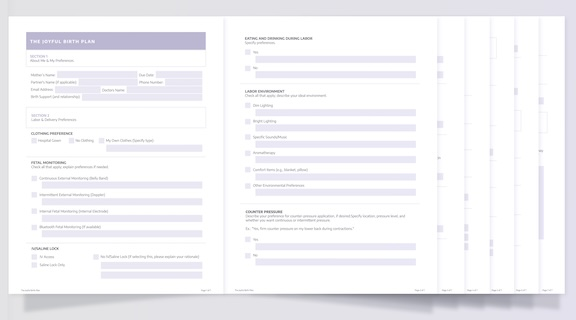
This template is also available as a fillable PDF and in the free True Joy Birthing app. Get the full version below.
Get the full template
Three ways to build your induction birth plan
Birth Plan Language Tips
How you say things matters as much as what you say. A few guidelines for your birth plan template and your induction birth plan:
- Use "I prefer" and "I'd like" instead of "I refuse" or "I insist." Firm preferences, respectful tone. Your birth plan is a communication tool, not a contract.
- Keep it short. Nurses read your plan in 30 seconds. Bullet points, one preference per line.
- Do not include requests that contradict hospital policy for inductions. If continuous monitoring is required, ask for the most freedom within that policy instead of fighting it.
- Write for the birth you are actually having, not the one you were originally planning. If you were planning an unmedicated home birth and now you are being induced at the hospital, adjust your plan accordingly.
The birth plan checklist helps you make sure you have covered everything. The free Joyful Birth Plan template organizes all of this by category with induction-specific sections included.
"I was so bummed when my provider said I needed to be induced at 39 weeks. I had planned an unmedicated birth and felt like the whole thing was ruined. But my doula helped me rewrite my plan for what was actually happening, and you know what? My induction was 14 hours, I got my epidural at 5 cm, and I still had a beautiful vaginal birth. The plan made me feel like I still had a say."
Kristen M., Fort Worth
Induction Birth Plan FAQ
Does being induced mean I'll end up with a cesarean?
How long does an induction take?
Can I eat during an induction?
Can I move around during an induction?
What if my induction doesn't work?
What's a Bishop score and why does it matter?
Is there a free induction birth plan template?
How do I write a birth plan for induction?
What should I include in an induction birth plan?
More Resources for Your Birth Plan
Your induction birth plan connects to the rest of your birth preparation. A birth plan for induction is just one piece, and these guides cover the full picture:
- What is a doula?: how a doula supports you specifically during an induction
- Benefits of a doula: shorter labors, fewer interventions, higher satisfaction
- Doula cost: what doulas charge and what is included
- How to choose a doula: interview questions, red flags, contract details
- Doula vs. midwife: the difference and why you might want both
- Hospital birth plan: what to include when delivering at a hospital
Free Download
Get the Free Video Walkthrough
Enter your name and email and we'll send you immediate access to all 5 walkthrough videos, a certified doula guiding you through every section of your birth plan. Already have the PDF? The videos work alongside it. No spam, just the guidance you need.
✓ Check your inbox. Your walkthrough access is on its way!
Your free video walkthrough is ready below. Start watching now.
Take your plan to the hospital
The app has your plan, contraction timing, and provider messages in one place.
No spam. Just your birth plan and occasional tips you can actually use.
Prefer to skip the email?
Download PDF directlyAlready have a plan? Book a Birth Plan Confidence Session
Want to understand every choice on it? Watch the free walkthrough
Keep Reading
Related Resources for Your Birth Plan
Everything you need to know, from what a doula does to how to build a complete birth plan. These guides walk you through each topic so you can make decisions with confidence.

Birth Plan Examples
Real-world birth plan examples for different scenarios, including induction and medicated birth.
Read more → Birth Plan Scenarios
Situation-specific guides for induction, C-section, VBAC, home birth, and more.
Read more →
Postpartum Doula Guide
Recovery support after birth: feeding help, emotional care, and what to expect in the first weeks home.
Read more →
Birth Plan FAQ
Common questions about birth plans, doulas, and what to expect answered in plain language.
Read more → Joyful Birth Plan Template
The complete Joyful Birth Plan template with induction-specific sections included. Free download.
Read more → Induction Birth Plan Guide
A deeper look at induction scenarios, medication options, and what to discuss with your provider.
Read more →