May 31, 2025
What to Include in a Birth Plan
Every section your birth plan needs, explained by a certified doula. From labor preferences to newborn care to backup plans — here's what actually matters.
You know you need a birth plan, but every template you find is either three pages of checkboxes or so vague it's useless. You keep staring at a blank page wondering what actually matters and what's just filler.
I get it. After supporting hundreds of births and writing plans for every scenario imaginable — from unmedicated home births to planned C-sections — I can tell you exactly what belongs in your birth plan and what doesn't. No fluff. Just the sections that actually help your care team support you the way you want.
Let me walk you through every section, what to include, and how to write it so your team actually reads it.
What Is a Birth Plan and Why It Matters
A birth plan is a one-page document that tells your care team what you want during labor, delivery, and the first hours with your baby. It's not a binding contract. It's not a demand list. It's a clear, concise way to share your priorities before you're too busy breathing to explain them.
The best birth plans accomplish three things:
- They start a conversation. Your provider sees your preferences and can flag anything that needs discussion before delivery day.
- They give nurses a quick reference. When your nurse is juggling multiple patients, your plan keeps your wishes visible.
- They keep your partner grounded. When things get intense, your partner has a written reminder of what you want.
Mothers who bring a birth plan consistently tell me they felt more confident going into labor. Not because everything went according to plan — it rarely does — but because they'd thought through their options ahead of time and knew their team had their back.
The 7 Sections Every Birth Plan Needs
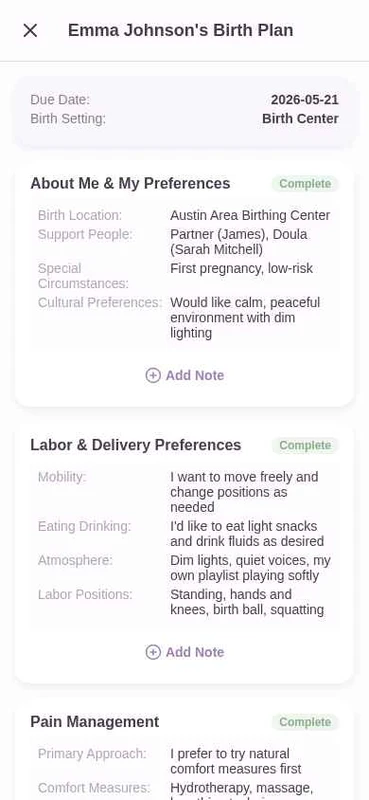
1. Labor Preferences
This section sets the tone for your entire birth experience. It covers how you want labor to unfold and what matters most to you during the process.
Include:
- Whether you want to labor at home as long as possible before going to the hospital or birth center
- Your ideal labor environment (dim lights, music, aromatherapy, privacy)
- Who you want in the room — partner, doula, family, and who you'd prefer to keep out
- Mobility preferences (walking, position changes, birth ball, hydrotherapy)
- Whether you want your provider to break your water or prefer it to happen naturally
- How you feel about artificial rupture of membranes (AROM) and induction augmentation
Write this section in clear, specific language. "I prefer a calm, quiet environment with dim lighting and minimal interruptions" gives your team something to work with. "Natural birth" doesn't.
2. Pain Management
Pain management is the section people agonize over — and overthink. Here's the truth: there's no right answer. There's your answer.
Include:
- Whether you want to try unmedicated labor, and for how long
- Your feelings about an epidural (want it available when you ask, want to labor without as long as possible, or definitely want one)
- Comfort measures you'd like to try (breathing techniques, position changes, warm compresses, massage, birth ball, water)
- Whether you want pain medication offered to you or only if you specifically request it
- Any allergies or sensitivities to medications
Be honest. If you think you'll want an epidural but want to try without for a while first, say that. If you're committed to unmedicated labor, say that too. The goal is clarity, not performance.
3. Delivery Preferences
This section covers what happens when it's time to push and meet your baby. It's about how you want the birth itself to unfold.
Include:
- Pushing position preferences (side-lying, squatting, hands and knees, semi-reclined, water birth if available)
- Whether you want to feel the urge to push spontaneously or be directed when to push
- Whether you want a mirror to see the birth
- Who you want to catch the baby
- Whether you want delayed cord clamping (at least 1-3 minutes)
- Skin-to-skin preferences immediately after birth
- Whether you want your partner to announce the sex of the baby
4. Postpartum Preferences
The first hour after birth is often called the golden hour. It's a big deal, but hospital routines can easily interrupt it unless you say otherwise.
Include:
- Immediate, uninterrupted skin-to-skin for at least the first hour
- Breastfeeding preferences (immediate latch, lactation consultant visit, no formula supplementation unless medically necessary)
- Delayed newborn bath (vernix is protective and beneficial)
- Whether you want privacy for the first hour with just your partner and baby
- Placenta delivery preferences
- Perineal care preferences
This section matters because postpartum protocols vary widely between hospitals. Without stating your preferences, you'll get whatever that facility does by default. If you're in the Chicago area, our Chicago birth support guide breaks down postpartum protocols at local hospitals so you can plan ahead.
5. Newborn Care
Your preferences for your baby deserve their own section. Hospital newborn procedures happen quickly, and many are done by default unless you specify otherwise.
Include:
- Feeding plan (exclusive breastfeeding, combination, pumping, donor milk if needed)
- Vitamin K injection preferences
- Eye ointment preferences
- Circumcision preferences (if applicable)
- Hepatitis B vaccine preferences (first dose or delaying)
- Newborn screening preferences
- Rooming-in preferences (baby with you at all times vs. nursery time)
- Whether you want all procedures explained before they happen
Our birth plan checklist covers every newborn decision point so you don't miss any.
6. C-Section Preferences
Skip this section and you're hoping your birth goes perfectly. About one in three hospital births ends in C-section. A backup plan doesn't mean you expect it — it means you're prepared for it.
Include:
- Whether you want your partner in the OR
- Clear drape preference so you can see the birth
- Skin-to-skin in the OR if medically possible
- Whether you want the surgeon to narrate what's happening
- Whether you want your same newborn care preferences to apply
- If it's an unplanned C-section, whether you want to try other interventions first
A C-section is still your birth. Your preferences still matter. Write them down.
7. Unexpected Situations
Nobody wants to think about the scenarios in this section. But being prepared doesn't cause bad outcomes — it just means you're ready for whatever comes.
Include:
- If labor stalls: how long you'd like to try before augmentation, and which methods you'd prefer
- If baby needs NICU care: who goes with the baby, who stays with you, how you want updates
- If you need to make decisions mid-labor: you want to be informed before any intervention
- If you're unable to make decisions: who speaks for you
- Blood transfusion preferences if needed
This section often gets skipped because it feels "negative." Let me reframe it: this section ensures that even in a hard moment, your voice is still present.
What Most Birth Plans Get Wrong
After reading hundreds of birth plans, here are the mistakes I see again and again:
Being too vague. "I prefer a natural birth" is a bumper sticker, not a plan. "I'd like to labor without pain medication for as long as possible. Please don't offer an epidural — I'll ask if I want one" is a plan your nurse can actually follow.
Being too long. Your labor nurse has maybe five minutes between patients to read your plan. If it's two pages of dense text, she'll skim it. One page, clear headings, bullet points. That's the format that gets read.
No backup plan. A birth plan that only covers the perfect scenario becomes useless the moment things shift. Include your preferences for C-section, induction, and unexpected situations — not because you expect them, but because you deserve a voice no matter what.
Forgetting your partner's role. Your partner isn't just there for moral support. Tell your team how you want your partner involved — counter-pressure, reminding you of your preferences, being the one to announce the baby's sex, cutting the cord.
Ignoring hospital-specific policies. Every hospital has different standard procedures. A plan that works perfectly at one hospital might conflict with routine at another. Talk to your provider about what's typical at your location. For example, if you're in the Phoenix area, our Phoenix birth support guide covers local hospital policies so you can align your plan with what to expect.
For examples of birth plans that work — and ones that don't — our birth plan examples page breaks down real plans with notes on what's effective and what to change.
Birth Plan Examples: What Works vs. What Doesn't
Let me show you the difference.
What doesn't work:
"I want a natural birth with minimal interventions. I prefer a calm environment and would like to avoid pain medication unless absolutely necessary. I want my partner there and hope for skin-to-skin right away."
This tells your nurse almost nothing usable. "Natural birth" means something different to every person. "Minimal interventions" doesn't specify which ones. "Unless absolutely necessary" leaves the definition to someone else.
What works:
Labor: I'd like to labor without pain medication for as long as possible. Please don't offer an epidural — I'll ask if I want one. I'd like to be upright and mobile during early labor, and I plan to use a birth ball and breathing techniques.
Environment: Dim lights, quiet room, music playing (bring speaker). Partner and doula present. No additional visitors without my request.
Pain management: Try hydrotherapy, position changes, and massage first. If I request medication, I want to discuss options before anything is administered.
Delivery: I'd like to push in whatever position feels right. Delayed cord clamping for at least 2 minutes. Immediate skin-to-skin, uninterrupted first hour.
See the difference? The second version is specific, actionable, and easy for any nurse to follow — even in a busy hospital.
Free Birth Plan Template
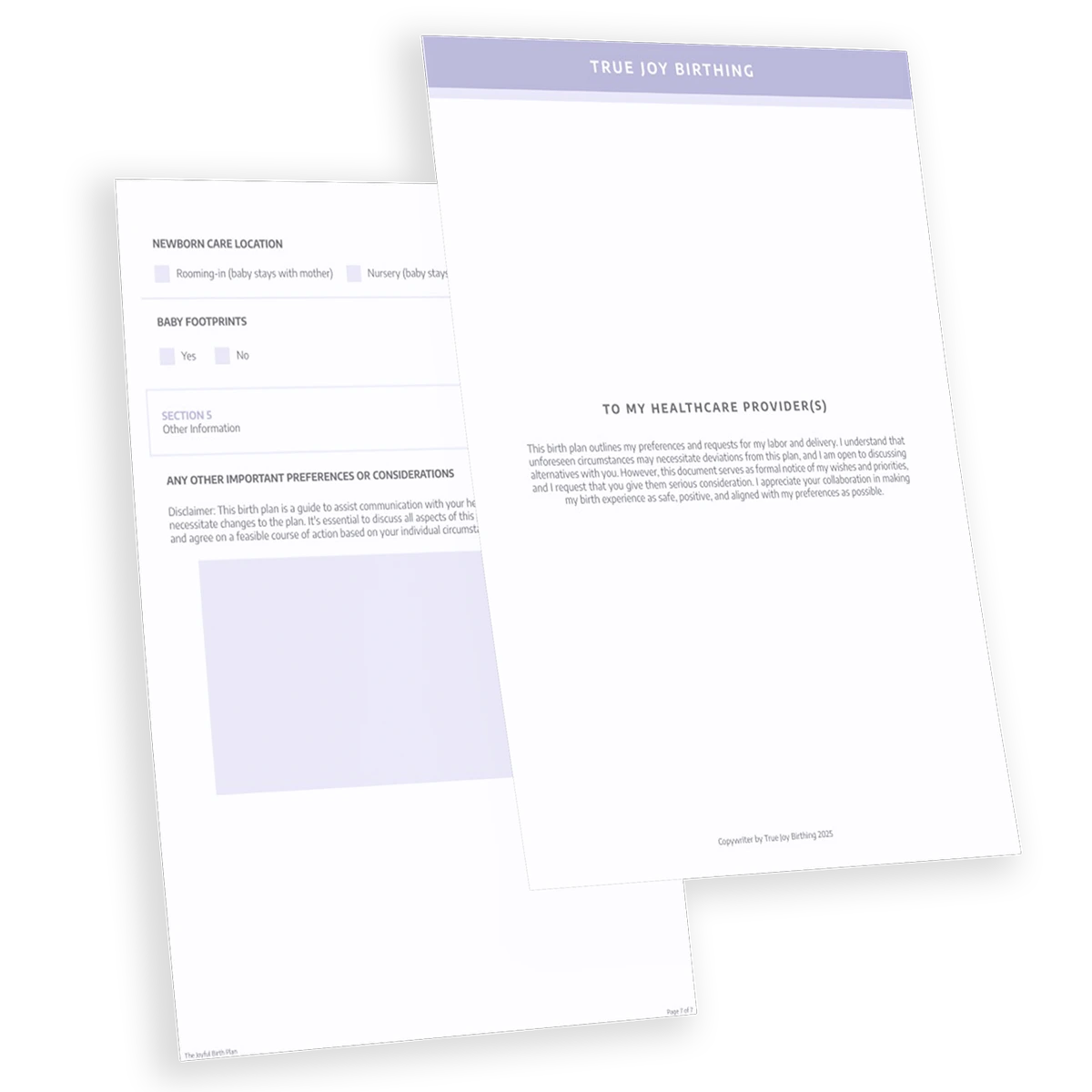
Ready to write your plan? Our free birth plan template gives you the exact framework — fill in your preferences for each section, print it, and bring it to your next prenatal visit.
It covers all seven sections above with prompts for each preference. No filler, no three-page questionnaires. Just what your care team needs to know.
Birth Plan Checklist
If you're the type who likes to make sure nothing slips through the cracks, our birth plan checklist is for you. It walks you through every decision point, from labor preferences to newborn procedures, so you can check off what matters to you and skip what doesn't.
Use the checklist alongside the template for a complete birth plan that covers everything — and nothing extra.
Birth Plans for Specific Situations
Not every birth starts the same way. If your situation has specific needs, these guides go deeper:
- Induction planned? Our induction birth plan template covers what changes when labor is started medically — timing, pain management differences, and how to advocate for yourself during a longer process.
- C-section planned or possible? Our C-section birth plan walks you through surgical birth preferences — from clear drapes to skin-to-skin in the OR.
- Planning a home birth? Our home birth plan covers what's different when you're planning to birth at home — transfer plans, supply lists, and how to prepare your space.
Hospital policies look different depending on where you live. For local details on hospital policies, doula availability, and birth center options, check our city guides: Austin, TX, Beaumont, TX, and Aurora, CO.
How to Talk to Your Provider About Your Birth Plan
Writing the plan is step one. Sharing it is where it becomes real. Here's how to make that conversation productive:
Bring it up around 34-36 weeks. This gives your provider time to review it and discuss any concerns before you're in labor. Earlier is fine too, but 34-36 weeks is the sweet spot — your plan is fairly complete and your provider still has time to work with it.
Bring a printed copy. Handing your provider a physical document makes it real. Ask them to keep it in your chart. Bring extra copies for delivery day.
Ask open-ended questions. Instead of "Is this okay?" try "How does this plan fit with the way you typically manage labor?" or "What concerns do you have about any of these preferences?" You'll learn more that way.
Be willing to adjust. Your provider might flag something that conflicts with hospital policy or best practice. That's not a rejection — it's valuable information. Use it to refine your plan.
Revisit it if things change. Pregnancy isn't static. If your situation changes — a new diagnosis, a change in baby's position, a different birth setting — update your plan and share the revised version.
Bring it on delivery day. Hand it to your triage nurse when you arrive. Ask your partner to mention it again when you're settled in your room. This isn't pushy — it's prepared.
Your birth plan is one of the most practical tools you have for shaping your birth experience. Start with our free birth plan template, make it yours, and take it to your next prenatal appointment. The conversation it starts might be the most important one you have before delivery day.
Written by Shelbi Kohler