
Paying for a Doula
Medicaid Doula Coverage: Which States Pay for Your Birth Support?
More than a dozen states now cover doula services through Medicaid, and the list is growing. Here's exactly where coverage exists, what it includes, how to use it, and what to do if your state hasn't caught up yet.
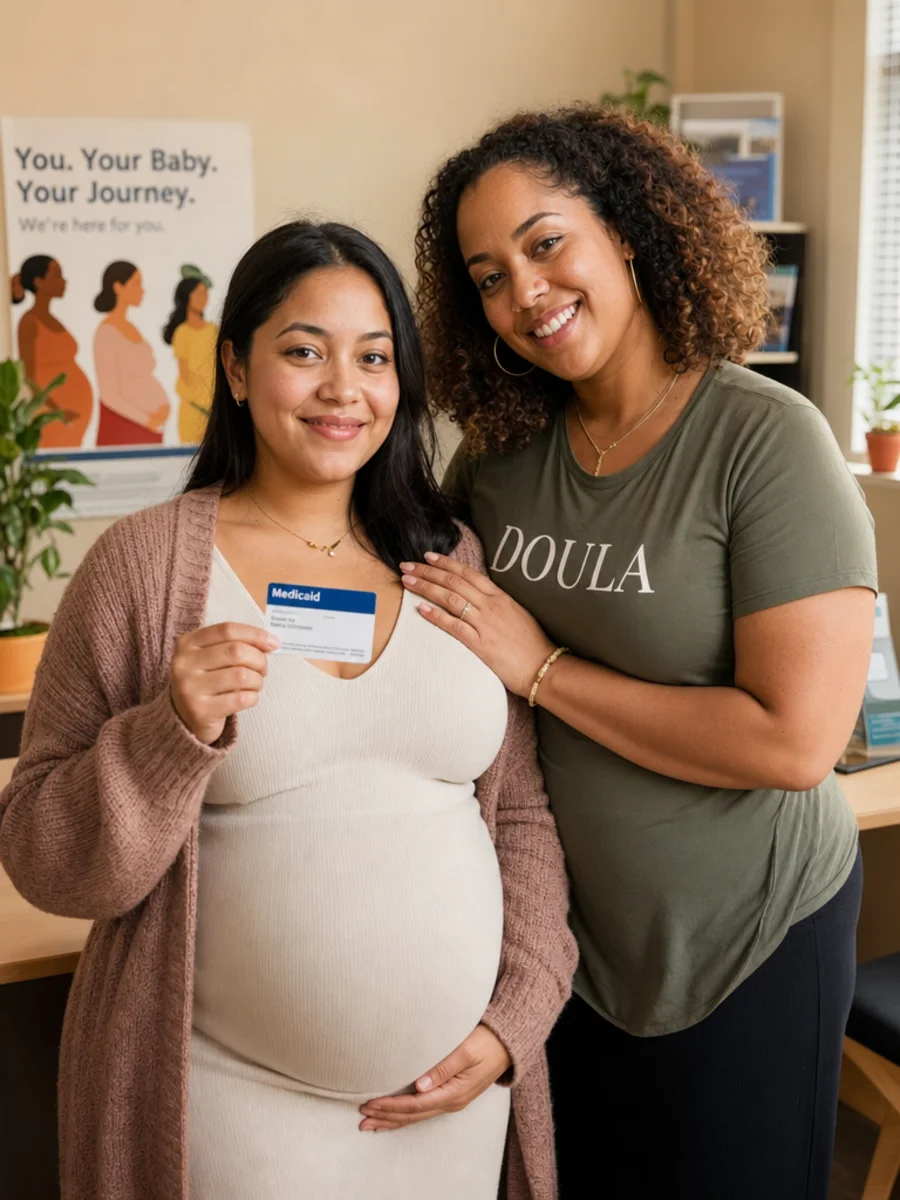
Does Medicaid Cover Doula Services?
Yes, but not everywhere, and not in the same way. Medicaid doula coverage is expanding rapidly across the United States, driven by growing evidence that doula support improves birth outcomes. As of 2025–2026, more than a dozen states have enacted policies that allow Medicaid to reimburse doula services, and several more have legislation pending or pilot programs in development.
The push for Medicaid doula coverage didn't come from nowhere. Black women in the U.S. are nearly three times more likely to die from pregnancy-related causes than white women, according to the CDC. Indigenous women face similarly devastating disparities. Doulas, particularly community-based doulas who share cultural backgrounds with the families they serve, have been shown to narrow those gaps. If you're also thinking about what a doula actually does day to day, we break that down separately. State legislatures and the federal Centers for Medicare & Medicaid Services (CMS) have taken notice.
The 2021 CMS guidance encouraging states to cover doula services under Medicaid was a turning point. It clarified that doulas could be reimbursed as a covered benefit and gave states a framework for structuring coverage. Since then, the pace of adoption has accelerated significantly.
But here's what makes Medicaid doula coverage complicated: every state designs its own Medicaid program within federal guidelines. That means coverage amounts, eligible providers, covered services, and reimbursement rates vary wildly. What Oregon offers is not what New Jersey offers. What California reimburses may be double what Virginia allows. This guide breaks it down state by state so you know exactly what's available where you live.
States That Cover Doulas Through Medicaid
As of early 2026, the following states have some form of Medicaid doula coverage in effect. The distinction between full statewide coverage and pilot programs matters, a pilot may limit which counties, which doulas, or how many clients can be served.
Full Statewide Coverage
These states have implemented Medicaid doula coverage across their entire Medicaid population:
- Oregon: The pioneer. Oregon became the first state to cover doulas under Medicaid in 2014 through its Coordinated Care Organizations. Coverage includes prenatal, labor, and postpartum visits with reimbursement rates set by individual CCOs, typically ranging from $350 to $1,500 per client.
- Minnesota: Enacted coverage in 2014. Minnesota reimburses doulas as certified Medicaid providers. Coverage includes up to 12 total visits (prenatal, labor, and postpartum combined). The state-established reimbursement rate is approximately $47 per visit for prenatal/postpartum and $469 for the labor support package.
- New York: Effective January 2019, New York expanded Medicaid to cover doula services statewide. The benefit includes up to four prenatal visits, labor and delivery support, and up to four postpartum visits. New York set reimbursement at $600 total for the full package, with an additional $150 available for doulas who complete state-approved training.
- Colorado: Colorado began reimbursing for doula services under Medicaid in 2022. The state covers prenatal, intrapartum, and postpartum doula care. Colorado's Medicaid reimbursement is approximately $1,000 for the full course of care.
- California: California's Medicaid program (Medi-Cal) began covering doula services in July 2022 under SB 65. Coverage includes up to two prenatal visits, labor and delivery, and up to two postpartum visits, plus additional postpartum visits with prior authorization. Reimbursement rates are approximately $158 per prenatal/postpartum visit and $907 for labor and delivery, among the highest in the nation.
- Virginia: Virginia authorized Medicaid doula coverage effective July 2021. The state covers up to two prenatal visits, labor support, and two postpartum visits. Virginia's total reimbursement is capped at approximately $1,200 per pregnancy.
- Washington: Washington State began covering doula services under Medicaid in 2023. Covered services include up to two prenatal visits, continuous labor support, and two postpartum visits. Reimbursement is structured at approximately $300 for prenatal, $700 for labor, and $300 for postpartum support.
- New Jersey: New Jersey enacted Medicaid doula coverage effective January 2021. The benefit covers up to six total visits including prenatal, labor, and postpartum. New Jersey's reimbursement rate totals approximately $600 for the full package.
- Illinois: Illinois launched full Medicaid doula coverage in 2022. The program covers prenatal visits, labor support, and postpartum visits. Illinois set reimbursement at approximately $50 per visit for prenatal/postpartum and $350 for labor support.
- Maryland: Maryland began covering doula services under Medicaid in 2022. Coverage includes prenatal, intrapartum, and postpartum support. The state reimburses at approximately $600 for the full service package.
- Connecticut: Connecticut authorized Medicaid doula coverage in 2022. The benefit covers up to 12 visits across the prenatal, labor, and postpartum periods. Reimbursement is structured at approximately $50 per visit for routine visits and $500 for the labor support component.
- Michigan: Michigan implemented Medicaid doula coverage in 2023. Covered services include prenatal, labor, and postpartum doula care. Michigan's reimbursement totals approximately $750 for the full package of care.
- Nevada: Nevada began Medicaid doula coverage in 2023. The state covers up to two prenatal visits, labor support, and two postpartum visits. Reimbursement is approximately $500 for the complete benefit.
Pilot Programs and Pending Legislation
Several states have launched limited pilot programs or have active legislation that could expand coverage soon:
- Massachusetts: A pilot program launched in 2023 covering doulas in select regions. Full statewide expansion is under legislative consideration.
- Texas: Legislation has been introduced in multiple sessions but has not yet passed. Some managed care organizations in Texas are voluntarily covering doula services outside the Medicaid framework.
- Georgia: A Medicaid doula pilot was explored in 2024. Implementation status varies by region.
- North Carolina: Legislation introduced in 2023–2024 would authorize Medicaid doula coverage. As of early 2026, it remains in committee.
- Pennsylvania, Arizona, and Ohio: All have had doula coverage legislation introduced but not yet enacted into law.
Important
Medicaid doula coverage is evolving quickly. States frequently update their reimbursement rates, covered visit limits, and provider qualification requirements. Always verify current coverage with your state's Medicaid agency or your managed care plan before hiring a doula. The information above reflects policies in effect as of early 2026 but may have changed since publication.
What Medicaid Doula Coverage Includes
Medicaid doula coverage is not a blank check. States define specific services, visit limits, and reimbursement structures. Here's what's typically covered, and where the gaps are.
Covered Services
Most state Medicaid programs that cover doulas include some version of the following:
- Prenatal visits: Typically 1 to 4 visits before birth. These meetings cover birth plan development, childbirth education, emotional support, and preparation for the labor experience. Some states cap these at 2; others allow up to 4 or more with prior authorization.
- Labor and delivery support: Continuous in-person support from the onset of active labor through delivery. This is the core doula service and is covered in every state with Medicaid doula coverage. Some states reimburse this as a single flat fee; others break it into hourly increments.
- Postpartum visits: Typically 1 to 4 visits after birth. These cover breastfeeding support, newborn care guidance, emotional processing of the birth experience, and referrals to additional services. States that have extended Medicaid postpartum coverage to 12 months (as required under the American Rescue Plan Act) may allow more postpartum doula visits.
Visit Limits
Most states set a cap on the total number of doula visits covered. Common structures include:
- 6-visit models (New Jersey, Virginia): 2 prenatal + labor + 2 postpartum
- 9-visit models (California): 2 prenatal + labor + 2 postpartum (standard), with additional postpartum visits by prior authorization
- 12-visit models (Minnesota, Connecticut): Up to 12 total visits across all phases of care
Reimbursement Rates
Reimbursement rates vary dramatically. Here's the reality: in many states, the Medicaid reimbursement rate is significantly lower than what doulas typically charge private-pay clients. This creates a tension between access (the benefit exists on paper) and availability (doulas willing to accept the rate).
- Highest rates: California ($907 for labor and delivery alone, plus per-visit rates), Washington ($1,300+ total), Colorado (~$1,000 total)
- Middle range: Virginia (~$1,200), Michigan (~$750), Oregon ($350–$1,500 depending on CCO)
- Lowest rates: Illinois (~$600 total), New Jersey (~$600 total), Minnesota ($47/visit + $469 labor)
When reimbursement is low, some doulas choose not to accept Medicaid clients, not because they don't want to, but because they can't sustain a practice on those rates. This is one of the biggest challenges in Medicaid doula coverage right now. For context on what doulas typically charge private-pay clients, see our complete doula cost guide. Advocacy organizations like the National Health Law Program and Health Law Partners continue to push for reimbursement rates that reflect the true value and cost of doula care.
How to Get Medicaid to Cover Your Doula
If you live in a state with Medicaid doula coverage, here's how to actually use it. The process isn't always straightforward, but these steps will help you navigate it.
- Confirm your Medicaid enrollment. Make sure you're enrolled in your state's Medicaid program and know which managed care plan you're in (if applicable). In some states, the managed care organization, not the state directly, handles doula reimbursement.
- Find a Medicaid-enrolled doula. Not every doula accepts Medicaid. Your state Medicaid agency, managed care plan, or local health department should have a list of enrolled doulas. You can also ask doulas directly if they are Medicaid providers. In some states, doulas must complete specific certification or training to bill Medicaid. See our guide on how to choose a doula for interview questions and what to look for.
- Get a referral if required. Some states require a physician, midwife, or other licensed provider to refer you for doula services. Ask your prenatal care provider if a referral is needed and request one early, don't wait until you're in labor.
- Understand your visit limits. Know how many prenatal, labor, and postpartum visits your state covers so you and your doula can plan accordingly. If you think you'll need more visits than the limit allows, ask about prior authorization for additional visits.
- Verify billing before services begin. Confirm with your doula and your Medicaid plan that the services will be billed correctly. Some doulas bill directly; others work through a billing organization or community-based program that handles Medicaid reimbursement on their behalf.
- Keep documentation. Save any referral letters, visit records, and receipts. If there's a billing issue, and there sometimes is, having documentation makes it much easier to resolve.
"I didn't even know Medicaid covered doulas until my caseworker mentioned it at my 20-week appointment. I found a doula who accepted Medicaid within a week, and she was incredible. But I almost missed out because nobody told me it was an option."
Keisha T., Medicaid recipient, Minneapolis
What If Your State Doesn't Cover Doulas Through Medicaid?
If your state hasn't enacted Medicaid doula coverage yet, you still have options. Don't assume a doula is out of reach.
Sliding-Scale Doulas
Many doulas, especially those who trained specifically to serve under-resourced communities, offer sliding-scale fees based on your income. A doula who normally charges $1,500 might work with you for $300 to $500. Community-based doula organizations and collectives often have formal sliding-scale programs. Ask directly. Most doulas would rather work with you at a reduced rate than see you go without support.
Pro Bono and Volunteer Doulas
Hospital-based volunteer doula programs exist in many cities. These programs train doulas who then provide free labor support to patients at participating hospitals. The catch: you usually don't meet your doula before labor day, and they may not provide prenatal or postpartum visits. Still, free labor support from a trained professional is far better than none. Check with your delivering hospital to see if they have a volunteer doula program.
Some community organizations also offer free or donation-based doula services, particularly for Black, Indigenous, and other families of color. Organizations like HealthConnect One and local chapters of the National Association to Advance Black Birth can connect you with resources.
Health Savings Accounts (HSA) and Flexible Spending Accounts (FSA)
If you have an HSA or FSA through your employer, you may be able to use those funds to pay for doula services. Doulas don't always appear on the IRS list of qualifying medical expenses, but many HSA/FSA administrators approve doula costs with a letter of medical necessity from your provider. Ask your OB or midwife to write one, it takes five minutes and can unlock hundreds of dollars in pre-tax funds.
Insurance Appeals
Even if your insurance (Medicaid or private) doesn't cover doulas as a standard benefit, you can file an appeal or request an exception. This works more often than people think. Get a letter from your provider explaining why doula support is medically necessary, cite the Cochrane review data, the CDC maternal mortality statistics, and any personal risk factors. Submit a formal appeal through your plan's grievance process. Persistence matters here. Many initial denials are overturned on appeal.
Employee Assistance and Community Programs
Some employers offer birth support benefits through employee assistance programs. Local WIC offices, community health centers, and faith-based organizations sometimes have doula partnerships or voucher programs. It's worth making a few phone calls before assuming you have to pay full price.
Using the Birth Plan with Medicaid
Whether your state covers doulas through Medicaid or not, a written birth plan is one of the most powerful tools you have. Here's why it matters even more when you're navigating Medicaid.
Medicaid patients are more likely to deliver at hospitals with higher intervention rates, less likely to have continuity of care with a single provider, and less likely to feel that their preferences were respected during labor. A birth plan doesn't fix systemic problems, but it does give you a voice in a system that often doesn't listen. If you're exploring your birth setting options, hospital, birth center, or home, our guide to finding a birth center near you can help you understand what's available.
When you write your birth plan using the free Joyful Birth Plan template, you're doing three things at once:
- You're making your preferences known. Labor preferences, pain management choices, who you want in the room, what happens if things change, it's all documented before you're in pain and can't speak clearly.
- You're giving your doula a roadmap. If you have a doula, whether Medicaid-covered, sliding-scale, or volunteer, your birth plan tells them exactly what you want so they can advocate for you in the moment.
- You're creating shared understanding with your provider. When your OB or midwife reviews your birth plan at a prenatal visit, it opens a conversation about what's realistic, what's available at your hospital, and where there's room to negotiate.
The Joyful Birth Plan is free, and it's designed to work whether you have a full-service doula, a volunteer, or no doula at all. Download it, fill it out, and bring it to your next prenatal appointment.
Your Next Step: Start Your Birth Plan
Understanding Medicaid doula coverage is important. Taking action is even more important. Here's where to start:
- 1. Download Your Birth Plan, The Joyful Birth Plan template gives you the structure. Start there.
- 2. Watch the free walkthrough, Walk through every section with a doula's context. Free with your email.
- 3. Book a Birth Plan Confidence Session, Review your completed plan with a certified doula line by line. $250 per session.
Medicaid Doula Coverage FAQ
Does Medicaid cover doulas?
Which states cover doulas through Medicaid?
How much does Medicaid pay for a doula?
How do I find a Medicaid doula?
What if my state doesn't cover doulas through Medicaid?
What services does Medicaid doula coverage include?
Can I use my birth plan with a Medicaid doula?
Free Download
Get the Free Video Walkthrough
Enter your name and email and we'll send you immediate access to all 5 walkthrough videos, a certified doula guiding you through every section of your birth plan. Already have the PDF? The videos work alongside it. No spam, just the guidance you need.
✓ Check your inbox. Your walkthrough access is on its way!
Your free video walkthrough is ready below. Start watching now.
Take your plan to the hospital
The app has your plan, contraction timing, and provider messages in one place.
No spam. Just your birth plan and occasional tips you can actually use.
Prefer to skip the email?
Download PDF directlyAlready have a plan? Book a Birth Plan Confidence Session
Want to understand every choice on it? Watch the free walkthrough
Want more than a template? Watch the free walkthrough, walk through every choice with context.
Already have a plan? Book a Birth Plan Confidence Session, review it with a doula line by line.
Free Birth Plan Template
Write Your Birth Plan, Whether You Have a Doula or Not
Medicaid coverage for your doula is great. A birth plan that gives you a voice in the delivery room is essential. Download the free Joyful Birth Plan template and start documenting your preferences today.
Get the Joyful Birth Plan →Related Resources
How Much Does a Doula Cost?
City-by-city pricing, what's included in a package, and affordable options near you.
What Is a Doula?
The complete guide: what doulas do, the three types, and why the evidence supports hiring one.
Benefits of a Doula: What the Research Says
28% fewer C-sections, shorter labors, and higher satisfaction with continuous support.
Find Birth Support in Your City
Local doulas, hospital policies, and Medicaid coverage. Browse 131+ city guides.