June 13, 2026
Birthing Center vs Hospital: Which Fits?
Compare birthing centers and hospitals to find the right setting for your birth plan — covering medical support, comfort, costs, and what each option offers.

When I sit down with families for the first time, the question that comes up almost every single time is: "Should I give birth at a hospital or a birth center?" It's a big question — and honestly, there's no universal answer. The right choice depends on your health, your values, and what kind of experience you want to carry with you for the rest of your life.
I've supported births in both settings, and I've seen families thrive in each one. What matters most is that you make the decision with your eyes wide open, understanding what each environment actually offers — not just what the brochures say. Let's walk through the real differences so you can figure out which setting fits you.
Understanding the Two Settings
A hospital birth takes place in a medical facility staffed by obstetricians, midwives, anesthesiologists, and nurses trained in managing both routine and complex deliveries. Hospitals are equipped with operating rooms, neonatal intensive care units (NICUs), and every medical tool available for managing complications.
A birth center birth takes place in a freestanding or attached facility designed specifically for healthy, low-risk pregnancies. Birth centers are typically staffed by certified nurse-midwives (CNMs) and offer a more home-like atmosphere — think queen-size beds, dim lighting, and tubs for hydrotherapy — while still maintaining medical equipment and emergency transfer protocols.
Both settings can provide excellent care. The difference lies in the philosophy driving that care. Hospitals are built to manage risk. Birth centers are built to support physiologic birth. Neither approach is wrong — but they feel very different in practice, and understanding that distinction is where your decision begins.
Medical Support and Intervention Rates
This is often the first thing families want to understand, and for good reason. The level of medical support available — and how often it's used — varies significantly between the two settings.
Hospitals have immediate access to surgical teams, anesthesia, NICU-level newborn care, and every intervention from Pitocin augmentation to emergency C-section. If something shifts during labor — fetal distress, preeclampsia, or a prolapsed cord — you're already in the building. That's the advantage. The trade-off is that interventions are also more routinely offered, and sometimes initiated, even when labor is progressing normally. The national C-section rate in hospitals hovers around 32%, and rates of induction and augmentation are higher still. If you know ahead of time that you'll be induced, an induction birth plan template helps you write preferences specific to that process.
Birth centers operate with a "watchful waiting" approach. Intermittent fetal monitoring replaces continuous monitoring. IVs are placed only when clinically indicated. Pitocin is not available — if labor stalls and augmentation becomes necessary, you transfer to a hospital. Birth center C-section rates typically range from 5-8%, partly because they serve a low-risk population and partly because the model of care supports physiologic labor patterns.
If you want an epidural, a birth center is not the right choice — epidurals aren't offered there. If you're planning an unmedicated birth and want to avoid the cascade of interventions, a birth center is designed exactly for that. And if your pregnancy is high-risk in any way — twins, breech, prior C-section, gestational diabetes requiring medication — a hospital is the safer setting, period.
Comfort, Environment, and Autonomy
Birth is not just a medical event. It's a deeply personal, physical, and emotional experience, and the environment where it happens matters more than most people realize.
In a hospital, you'll typically labor in a clinical room with a bed, monitors, and fluorescent lighting. Some hospitals have made real efforts to create more welcoming spaces — dimmable lights, tubs, and birth balls — but you're still in a medical building with shift changes, protocols, and policies that may not align with your preferences. You may be told when to eat, when to push, and how long you can labor before interventions are recommended. That said, many hospitals now have midwifery practices and more flexible policies than they used to, and I've seen beautiful hospital births where families felt genuinely supported.
In a birth center, the space is designed to help your body do what it already knows how to do. You can move freely, eat and drink throughout labor, labor in a tub, choose your delivery position, and keep lighting low. There are no shift changes — typically one midwife and one or two support staff stay with you from start to finish. The rooms feel like a comfortable bedroom, not a medical suite, and that sense of safety and privacy can make a real difference in how labor progresses. Families I've worked with through our Colorado birth support services have consistently described how that home-like environment helped them feel calm and in control throughout labor.
One mom I worked with in Dallas described her birth center experience this way: "I didn't feel like a patient. I felt like I was having a baby in my own home, except someone was making sure everything was safe." That's the birth center ethos in a sentence.
Cost Comparison
Cost is a practical concern that doesn't get enough attention in these conversations. Birth centers are almost always less expensive than hospital births — often significantly so.
A typical hospital vaginal delivery with insurance can still cost thousands in out-of-pocket expenses, depending on your plan. Without insurance, the range is roughly $10,000–$30,000 or more, especially if you factor in anesthesia, NICU time, or an unexpected C-section.
A birth center birth typically runs $3,000–$8,000 total, and many birth centers offer all-inclusive packages covering prenatal care, the birth, and postpartum follow-up. Insurance coverage for birth centers is improving — many plans now cover midwifery care and birth center delivery — but you need to verify with your specific provider. Some birth centers also accept Medicaid, which can make them accessible to families who might otherwise face financial barriers.
If you're in Texas, I'd encourage you to check out our Texas birth support hub for state-specific information on Medicaid coverage and local options. For families I've supported in Austin and Beaumont, the cost difference between a birth center and hospital delivery has been a real factor in their decision — and in many cases, the birth center option saved them thousands.
Transfer Protocols and What Happens If Plans Change
Here's something I want every family to understand: birth plans are wishes, not contracts. Sometimes labor takes a turn, and the setting that felt right at 37 weeks might not be the right one when you're in active labor. That's okay — it's why transfer protocols exist.
Birth center transfer rates range from roughly 10-15% for first-time parents and 5-8% for those who've given birth before. Transfers happen for reasons like prolonged labor, pain management requests, or non-emergent fetal heart rate changes. Emergency transfers are rare — roughly 1-2% — but birth centers have clear protocols for getting you to a hospital quickly when needed.
Hospital transfers don't exist in the same way because you're already there. If you start labor planning an unmedicated hospital birth and decide you want an epidural at 6 centimeters, you don't have to go anywhere. If a C-section becomes necessary, you're minutes from the OR. That built-in flexibility is one of the biggest advantages of a hospital birth.
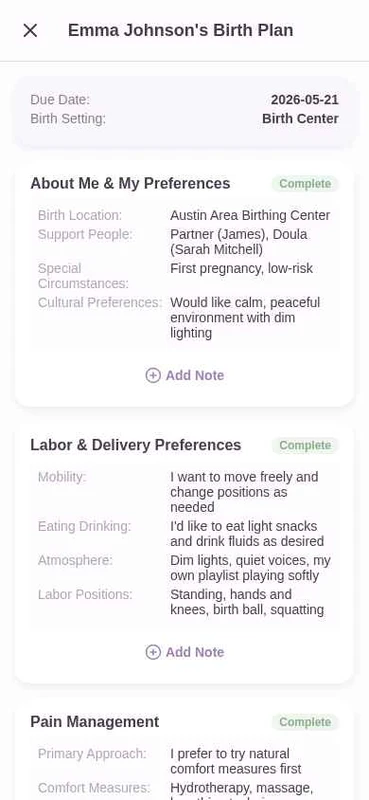
Whether you choose a birth center or hospital, I always recommend having a birth plan that includes your transfer preferences. What hospital would you transfer to? Who stays with you? What do you want carried over from your original plan? Thinking through these questions ahead of time reduces fear and confusion if things shift during labor.
Which Setting Is Right for You?
There's no wrong choice — only the choice that fits your circumstances and values. Here's a framework I walk families through:
A birth center may be the right fit if:
- You have a low-risk, uncomplicated pregnancy
- You want an unmedicated birth with minimal interventions
- Freedom of movement, hydrotherapy, and a home-like environment are priorities
- You value longer prenatal visits and a relationship with your midwife
- Cost is a significant factor and you want a more affordable option
- You're comfortable with the possibility of transfer (and have a plan for it)
A hospital may be the right fit if:
- You have any risk factors that require closer monitoring
- You want the option of an epidural or other pain medication
- You want immediate access to surgical intervention if needed
- You feel more secure in a medical environment
- Your insurance coverage is better for hospital births
- You prefer a longer postpartum stay (24-48 hours) for recovery and newborn monitoring
Many families I work with start at a birth center and transfer if needed, which is exactly how the system is designed. Others choose a hospital with a midwifery practice and get the medical backup they want with the holistic care they value. Both paths can lead to a positive, empowering birth. For example, families using our Austin birth support services have successfully navigated both birth center and hospital options, finding the right fit for their unique circumstances.
For a deeper dive into the decision-making framework, check out our complete birth setting guide — it walks through every factor in detail and includes a decision matrix to help you weigh what matters most.
What a Doula Brings to Either Setting
Here's something most people don't realize: a doula's support looks different depending on your setting, but it's equally valuable in both.
In a birth center, I'm often the continuity piece. Your midwife may have another client in labor, and in some centers, you might not meet the on-call midwife until you arrive. I'm the person who knows your preferences, your worries, and your partner's role — and I provide continuous support throughout your labor, whether you're laboring in the tub or deciding whether to transfer.
In a hospital, I'm your advocate in a system that can feel overwhelming. Hospital staff are rotating in and out, and they may not know your preferences. I help you understand what's being offered, what's required, and what's optional. I remind you of your birth plan when things get intense. I hold space so your partner can be present rather than overwhelmed. Whether you're delivering at a birth center or a hospital, having that consistent advocate by your side is invaluable — and families I've supported through our Portland birth support services have told me how much that continuity mattered in a hospital setting.
If you're still exploring birth center options in your area, our guide to finding a birth center near you covers what to look for, what questions to ask on a tour, and how to verify accreditation and licensing.
Making Peace With Your Decision
The hardest part of this choice isn't the logistics — it's the fear of making the "wrong" decision. I've seen families second-guess themselves for months, and I want to save you from that spiral.
Here's what I tell every client: the best birth setting is the one where you feel safe, respected, and supported. That's going to look different for every family. A first-time parent who wants the security of a hospital is making a great choice. A second-time parent who had a straightforward hospital birth and wants to try a birth center is making a great choice. The parent with gestational hypertension who needs a hospital birth is making a great choice.
Your birth matters. Your comfort matters. And the setting you choose should serve you — not the other way around.
If you're weighing your options and want to talk through what makes sense for your specific situation, reach out. I've walked this road with hundreds of families, and I'm happy to help you find the path that fits.
Written by Shelbi Kohler