June 13, 2026
Natural Labor Pain Management Techniques
Explore evidence-based, non-medication techniques for managing labor pain naturally — from breathing and movement to water therapy and positioning.

When I gave birth to my first baby, I thought pain management meant one thing: the epidural. Nobody told me there were other options — real, evidence-based techniques that could help me cope with contractions without medication. By my seventh birth, I had learned just how powerful my body could be when I had the right tools. Now, as a certified doula, I teach those tools to every family I support.
If you are planning a natural birth — or even if you just want to delay medication as long as possible — this guide is for you. I am walking you through the non-pharmacological pain management techniques that research supports and that I have seen work in hundreds of births. None of these require special equipment you cannot find in a standard hospital room or birth center, and all of them are things your partner or doula can help you do.
Understanding Why Labor Hurts
Labor pain is different from other pain. It is not a signal that something is wrong — it is a signal that your body is doing exactly what it needs to do. Contractions are powered by uterine muscles pulling your cervix open and guiding your baby down. That takes immense effort, and the sensation is intense by design.
Here is what matters: you do not have to fear that intensity. Fear creates tension, and tension makes pain worse. That feedback loop — fear, tension, pain — is well-documented in the obstetric literature. When you interrupt that loop with coping strategies, your perception of pain shifts. The contraction does not change, but your experience of it does.
Research published in Birth and the Journal of Perinatal Education consistently shows that people who use non-pharmacological comfort measures report higher satisfaction with their birth experience, even when they ultimately choose medication later. These techniques are not about suffering through labor. They are about giving yourself options and staying in the driver's seat.
Breathing Techniques That Actually Help
Breathing is the most accessible tool you have, and most people overlook it. I do not mean the patterned "hee-hee-hoo" breathing from sitcoms. I mean slow, intentional breathing that signals your nervous system to stay calm.
Slow breathing. Inhale through your nose for a count of four, exhale through your mouth for a count of six. Longer exhales activate your parasympathetic nervous system, which lowers your heart rate and reduces the stress response. Start this during early labor so it feels automatic by the time contractions intensify.
Breathing with a focal point. Some of my clients focus on a single object in the room — a photo, a candle, a partner's eyes. Others close their eyes and visualize warm water washing over them with each exhale. The research on visualization and guided imagery shows measurable reductions in pain perception during labor.
I practiced slow breathing so many times before my sixth birth that it became second nature. When transition hit hard and fast, my body defaulted to that rhythm without me even thinking about it. That is the goal — make it muscle memory before labor begins.
Movement and Position Changes
Lying flat on your back in a hospital bed is about the worst position for labor. It restricts your pelvis, slows progress, and makes every contraction feel harder. Movement, on the other hand, is one of the most effective comfort measures we have.
A Cochrane review found that upright positions during the first stage of labor — walking, swaying, slow dancing with your partner — are associated with shorter labors and less reported pain. Your baby needs gravity and movement to navigate the pelvis. When you stay mobile, you help that process along.
Positions I recommend trying:
- Walking and swaying during early and active labor
- Hands and knees — takes pressure off your back and gives your baby room to rotate
- Sitting on a birth ball — opens your pelvis and lets your hips move naturally
- Lunges and hip circles — help a baby who is in a less-than-ideal position adjust
- Side-lying with a peanut ball — great if you need monitoring but still want pelvic mobility
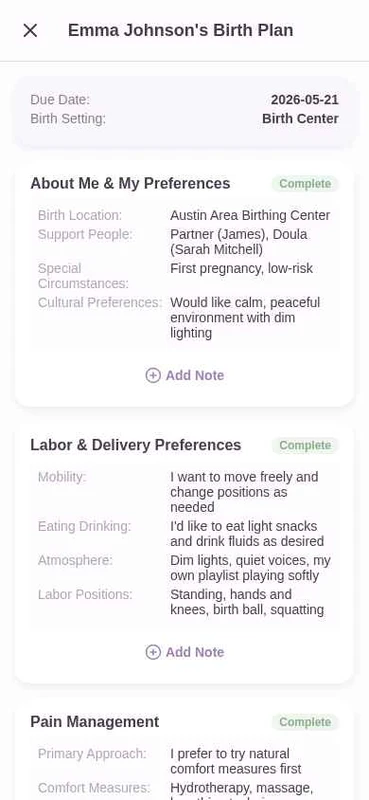
If you are planning a hospital birth, your hospital birth plan should include a note about freedom of movement. Many hospitals default to continuous monitoring and bed rest, but you can advocate for intermittent monitoring so you can stay active.
Hands-On Comfort Measures
This is where a doula makes the biggest difference. Hands-on techniques like counter-pressure, massage, and acupressure provide immediate relief for many laboring parents, and the evidence backs this up. A systematic review in The Journal of Perinatal Education found that continuous doula support — which includes hands-on comfort measures — reduces the likelihood of requesting pain medication by up to 28 percent.
Counter-pressure and hip squeezes. During back labor, pressure on your lower back can be transformative. Your partner or doula presses firmly on your sacrum or squeezes your hips together with both hands. I have watched clients go from crying through contractions to breathing calmly with consistent counter-pressure applied.
Massage. Light touch massage on your back, arms, or legs stimulates nerve pathways that compete with pain signals — this is called the gate control theory of pain, and it is the same principle behind TENS units. Firm massage on your shoulders and neck helps release tension you may not realize you are holding.
Acupressure. Specific points on the body — like the webbing between your thumb and index finger (LI4) or the inside of your ankle above the heel (SP6) — have been shown in clinical trials to reduce labor pain and even shorten the duration of labor. I teach these points to every partner at our prenatal meetings so they can step in between contractions.
If you want to learn more about how a doula provides this kind of support, read what a birth doula actually does — it goes far beyond what most people expect.
Water Therapy and Hydrotherapy
Water is one of the most underrated comfort measures in labor, and the research is clear: immersion in warm water during the first stage of labor reduces pain perception, lowers the use of epidural analgesia, and shortens labor. A landmark Cochrane review analyzed over 15 trials and found that water immersion significantly reduced the need for pharmacological pain relief.
Showering. Even if your hospital does not have birth tubs, most labor and delivery rooms have showers. Standing under warm water on your lower back during contractions can provide dramatic relief. I have had clients who spent most of their active labor in the shower and refused to get out.
Birth tub. If you are at a birth center or a hospital with tub access, water immersion changes everything. The buoyancy takes the weight off your joints, the warmth relaxes your muscles, and the sensory input of the water gives your brain something to focus on besides the contraction. Many of my clients describe getting into the tub as the moment labor shifted from overwhelming to manageable.
If you are in the Aurora area, several hospitals and birth centers offer tubs for labor — it is worth asking during your tour. And if you are planning a home birth, rental tubs are easy to find.
Mental Strategies and Visualization
Your mind is your most powerful tool in labor. The fear-tension-pain cycle I mentioned earlier works both ways: just as fear amplifies pain, confidence and calm reduce it. Mental strategies give you a framework for staying grounded when contractions intensify.
Visualization. Picture your cervix opening like a flower, or imagine each contraction as a wave that rises and falls. I had one client who visualized her baby moving down with every breath, and she said that image carried her through transition without medication.
Affirmations. Write them down, say them out loud, record them for your partner to play during labor. "My body knows how to do this." "Each contraction brings my baby closer." "I am safe. I am strong." It sounds simple, but positive self-talk changes how your brain processes pain signals.
Hypnobirthing techniques. If you want a structured program, hypnobirthing teaches self-hypnosis and deep relaxation for labor. Several randomized controlled trials have found that hypnobirthing reduces pain scores, anxiety, and the need for pharmacological pain relief. It takes practice during pregnancy, so start early — ideally by your second trimester.
Build these mental strategies into your birth plan template so your support team knows what words and images resonate with you. When you are deep in labor, having someone remind you of your own affirmations is a lifeline.
Creating Your Environment
Your surroundings affect how you experience labor more than most people realize. Bright overhead lights, beeping monitors, and clinical settings trigger your sympathetic nervous system — the fight-or-flight response that makes pain feel worse.
Dim the lights. Most hospital rooms have dimmer switches or you can bring battery-operated candles. Low lighting triggers melatonin release, which actually works alongside oxytocin to support labor progress.
Music. Create a playlist that calms you. Research shows that music therapy during labor reduces anxiety and pain perception. One mom I supported in Portland brought a speaker and played ocean sounds throughout her labor — she said it made the room feel like hers instead of a hospital's.
Aromatherapy. Lavender, clary sage, and citrus are the most commonly used essential oils for labor. A small randomized trial found that inhaling lavender during active labor significantly reduced pain scores compared to a control group. Put a few drops on a tissue or a diffuser necklace — hospitals generally do not allow plug-in diffusers.
Temperature. Warm rice socks on your lower back or a cool washcloth on your forehead. Heat relaxes muscles and cold provides a sensory distraction. Both interrupt the pain cycle in different ways.
Every one of these environmental adjustments belongs on your birth plan. If you are still building yours, grab our free birth plan template and start filling it in — it has a dedicated section for comfort preferences.
When Natural Techniques Are Not Enough
I believe in natural comfort measures because I have seen them work. I also believe in honesty. Sometimes labor is harder than anything you imagined. Sometimes techniques that worked beautifully at five centimeters stop working at eight. Sometimes you need an epidural after hours of back labor, and that is not a failure — that is you making a decision with the information you had in the moment.
Natural pain management is not about suffering to prove something. It is about having a full toolkit so you can choose what works for you, when it works. Maybe you use breathing and movement through early labor, water through active labor, and then decide you want medication during transition. Every one of those choices is valid.
What I want for you is a birth where you feel informed, supported, and respected — no matter how the pain management piece unfolds. If you want someone by your side who knows all of these techniques and can help you use them in real time, learn more about what a birth doula does. If you are in Colorado, check out our Colorado birth support hub for local resources, or find specific guidance for your area on our Colorado and Portland city pages.
You are capable of more than you think. Let's prepare together.
Written by Shelbi Kohler