June 14, 2026
Postpartum Emotional Care: Recovery
Learn to recognize baby blues vs postpartum depression, build a support network, and take real steps toward emotional recovery after birth.

Nobody hands you a manual on the way out of the hospital. They check your baby's weight, confirm you have a car seat, and send you on your way. What they don't always tell you is that the emotional aftermath of birth can hit harder than anything you experienced during labor.
I'm Shelbi Kohler, a birth doula and a mother of seven. I've lived through the fog, the tears that come out of nowhere, and the moments where you wonder if you're the only one who feels this way. You're not. And what you're feeling deserves just as much attention as any physical recovery.
This guide covers what I wish every parent knew about postpartum emotional health — from telling the difference between normal adjustment and something that needs clinical support, to building a network that actually catches you when things get hard.
Understanding Baby Blues
Let's start with what's typical. Roughly 70 to 80 percent of new parents experience what's commonly called the "baby blues" in the first few days after birth. If you're crying over a commercial, feeling overwhelmed by small tasks, or swinging between joy and sadness in the same hour — that's normal. Annoying, exhausting, and real, but normal.
Baby blues usually show up within two to three days after delivery and stick around for one to two weeks. They're driven by the massive hormone shift happening in your body, combined with sleep deprivation, physical recovery, and the sheer adjustment of keeping a tiny human alive.
What baby blues look like in practice:
- Mood swings — laughing one minute, sobbing the next
- Irritability — everything feels too loud, too bright, too much
- Tearfulness — crying without a clear reason
- Anxiety — worrying about whether you're doing things right
- Trouble sleeping — even when the baby is asleep
The key distinction: baby blues come in waves. You feel low, and then you feel okay again. They don't intensify over time. They don't make you feel disconnected from your baby. And they resolve on their own within that two-week window.
If you're past that window and things aren't improving — or if they're getting worse — that's a different conversation. And that's where we need to talk about postpartum depression.
When It's More Than Baby Blues: Recognizing Postpartum Depression
Postpartum depression (PPD) affects about 1 in 7 new parents. It's not a character flaw. It's not something you can think your way out of. And it's certainly not a sign that you don't love your baby. PPD is a medical condition that responds to treatment — but first, you have to recognize it.
Here's what PPD looks like compared to baby blues:
- Duration — symptoms last longer than two weeks and may get worse over time
- Intensity — the sadness, anxiety, or numbness feels constant, not wavelike
- Disconnection — feeling detached from your baby, like you're going through the motions
- Intrusive thoughts — upsetting mental images or fears that you can't shake
- Guilt and shame — convinced you're failing as a parent, even when evidence says otherwise
- Loss of interest — nothing feels enjoyable, including things that used to bring pleasure
- Physical symptoms — headaches, stomach problems, exhaustion that rest doesn't fix
- Difficulty functioning — struggling to eat, sleep, or handle daily tasks
PPD can show up anytime in the first year after birth — not just in those early weeks. Some parents feel fine initially and then hit a wall months later, especially around sleep regressions, returning to work, or weaning.
There's also postpartum anxiety (PPA), which shares some overlap with PPD but centers more on excessive worry, racing thoughts, and physical symptoms like a pounding heart or shortness of breath. PPA and PPD often occur together, and both are treatable.
If any of this sounds familiar, please read the section on seeking professional help below. You don't have to wait until things reach a crisis point.
Emotional Recovery After Birth
Physical recovery after birth gets a lot of attention — and it should. But emotional recovery is just as real, and in many ways, it takes longer. Your body is recalibrating hormones, your identity is shifting, and your daily reality looks nothing like it did before.
Here's what I tell every family I work with about the emotional recovery process:
Give yourself permission to grieve. Even when the outcome is a healthy baby, birth can involve loss — loss of the experience you imagined, loss of your pre-baby body, loss of autonomy and sleep. Grief doesn't require tragedy. It requires adjustment. Let yourself feel it.
Lower every standard that isn't safety-critical. The laundry can wait. The thank-you notes can wait. The home-cooked meals can become takeout. For the first several weeks, your job is feeding yourself, feeding your baby, and resting. That's it. Anything else is a bonus.
Watch your self-talk. When you catch yourself thinking "I should be able to handle this" or "other moms make it look easy," pause. Those comparisons are lies built from curated social media feeds. No one has it together in the fourth trimester. No one.
Track your emotional patterns. I recommend keeping a simple daily note — even just a number from 1 to 10 on how you're feeling. This makes it easier to spot trends. If your numbers are trending down week over week, that's useful information for your provider.
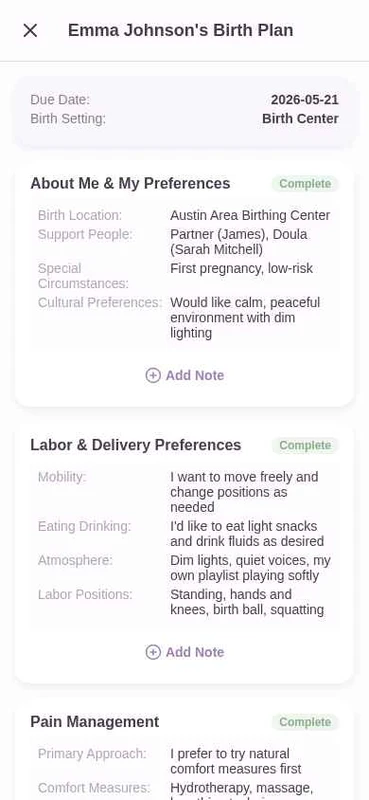
Having a birth plan template that includes your postpartum preferences — not just your labor preferences — can also help you think through your emotional needs in advance. Who's checking on you? Who's bringing food? Who's watching the older kids so you can rest? Planning for emotional support is just as important as planning for labor.
Building Your Postpartum Support Network
This is where a lot of families drop the ball. You plan the nursery, you stock the diapers, you install the car seat — but you don't build a support system for yourself. Let me be direct: you need one. Every new parent does.
Your support network should include:
A partner or co-parent who's educated about postpartum mental health. They need to know the signs of PPD and PPA so they can flag concerns early, not just say "you seem tired."
At least one person who checks on you, not just the baby. A friend, a sibling, a parent — someone who texts "how are YOU?" instead of "how's the baby?"
A postpartum doula. This is one of the best investments you can make in your recovery. A postpartum doula comes to your home and helps with newborn care, feeding support, light meal prep, and — critically — emotional check-ins with someone who's seen this process many times. Read more about what this looks like in our postpartum doula guide.
A healthcare provider you trust. Not just your OB or midwife for the six-week checkup. A therapist, counselor, or psychiatrist who specializes in perinatal mental health. You don't need to wait until you're struggling to establish this relationship.
Peer support. Whether it's a local new-parents group, an online community, or a circle of friends who've been through it — hearing from people who get it matters. Isolation feeds postpartum depression. Connection is part of the cure. If you're looking for local resources, our Austin birth support guide can connect you with doulas and postpartum services in the area.
If you're wondering whether a doula fits into your support plan, our article on how doula support helps breaks down the emotional and practical difference a doula makes during the postpartum period.
Practical Self-Care That Actually Helps
I'm not going to tell you to take a bubble bath. That's not the kind of self-care we're talking about here. Real postpartum self-care is less glamorous and far more necessary.
Sleep in chunks, not heroically. You will not get eight uninterrupted hours anytime soon. Instead, aim for multiple shorter stretches. Sleep when the baby sleeps is cliché because it works — but only if you actually do it. Close the door. Put your phone on do not disturb. Take the nap.
Eat food that requires zero effort. Stock your freezer before birth. Set up a meal train. Accept every offer of food. You need calories to recover and to produce milk if you're breastfeeding. This is not the time to worry about cooking.
Move your body — gently and gradually. Walking is enough. A ten-minute walk outside can shift your mood more effectively than scrolling your phone for an hour. Don't rush back into exercise. Your body just did something enormous.
Limit your screen time, especially social media. The comparison trap is brutal in the postpartum period. Everyone else's baby appears to be sleeping through the night. Everyone else appears to be thriving. It's not real. Set boundaries with your phone and protect your mental space.
Ask for help before you think you need it. This is the hardest one for most people. We wait until we're drowning to reach out. By then, we're too exhausted to coordinate help. Make a list now — while you're still pregnant — of three people you can call for anything. Text them before it becomes an emergency.
When to Seek Professional Help
This section could be the most important thing you read in this entire post. There is a line between "this is hard" and "I need help," and too many parents cross it without realizing.
Seek help immediately if you experience any of the following:
- Thoughts of harming yourself or your baby — even fleeting ones
- Inability to care for yourself or your baby for more than a day
- Severe anxiety that prevents you from sleeping when the baby sleeps
- Panic attacks — racing heart, difficulty breathing, feeling like something terrible is about to happen
- Feeling numb, empty, or detached for more than a few days
- Intrusive thoughts that scare you and won't go away
- Any thought that tells you your family would be better off without you
If any of these resonate with you, call your healthcare provider today — not next week, not at your next appointment. Today. You can also call or text the National Maternal Mental Health Hotline at 1-833-TLC-MAMA (1-833-852-6262), available 24/7.
For less urgent but still significant concerns:
- You've been feeling persistently low, anxious, or irritable for more than two weeks
- You're having trouble bonding with your baby
- You're avoiding social contact or losing interest in activities
- Your partner or loved ones have expressed concern about how you're doing
These are all valid reasons to reach out to a therapist who specializes in perinatal mental health. Postpartum Support International (PSI) has a free helpline and a directory of providers by state — that's a good place to start.
Finding local support matters too. If you're in Pennsylvania, our Pennsylvania birth support hub connects you with doulas, providers, and community resources across the state. For city-specific help, see our guides for Philadelphia birth support and Pittsburgh birth support, which include local postpartum resources and provider recommendations.
How Partners and Family Can Help
If you're reading this because someone you love just had a baby — thank you. Your role matters more than you know. Here's how to be effective:
Ask specific questions, not "let me know if you need anything." Instead, try: "Can I come over Tuesday and do the dishes?" or "I'm dropping off dinner tonight — any allergies?" Open-ended offers put the burden on the person who's already overwhelmed.
Watch for signs they may not recognize. You're in a better position to notice if someone is withdrawing, crying more than usual, or seeming disconnected from the baby. Bring it up gently and without judgment.
Take the baby so they can sleep. A real, uninterrupted stretch of sleep is one of the most generous things you can give a new parent.
Don't offer unsolicited advice. If they didn't ask, don't tell. Especially about feeding, sleep training, or parenting choices. They're getting enough opinions already.
Follow up. Check in again next week and the week after that. Most support floods in during the first two weeks and then disappears. The fourth, sixth, and twelfth weeks are often the hardest.
Moving Forward With Realistic Expectations
Recovery — emotional and physical — is not a straight line. You'll have good days and hard days. You'll feel like you're getting somewhere and then take two steps back. That's not failure. That's what recovery from a major life event looks like.
I've seen hundreds of families through this phase. The ones who do best are the ones who ask for help early, set realistic expectations, and give themselves grace when things are messy. Not the ones who power through alone.
If you're pregnant right now, start building your support team before the baby arrives. Talk to your provider about postpartum mental health resources. Consider hiring a postpartum doula. Fill your freezer. Make a plan for who's checking on you — not just the baby. And if you're in Colorado, our Aurora birth support guide can help you find local doulas and providers who understand postpartum mental health.
And if you're reading this in the thick of it, wondering if what you're feeling is normal: it might be. And it might not be. Either way, you deserve support. You deserve someone to talk to. You deserve to feel like yourself again.
You will get there. Just don't try to get there alone.
Written by Shelbi Kohler