December 8, 2024
Postpartum Doula: What They Do & When
What does a postpartum doula do? Learn how postpartum doula services help with newborn care, breastfeeding, sleep support, and recovery after birth.
What Does a Postpartum Doula Actually Do?
When I had my first baby, I had no idea how hard the days after birth would be. By baby number seven, I'd figured out that the families who ask for help early are the ones who actually enjoy those first weeks — instead of just surviving them.
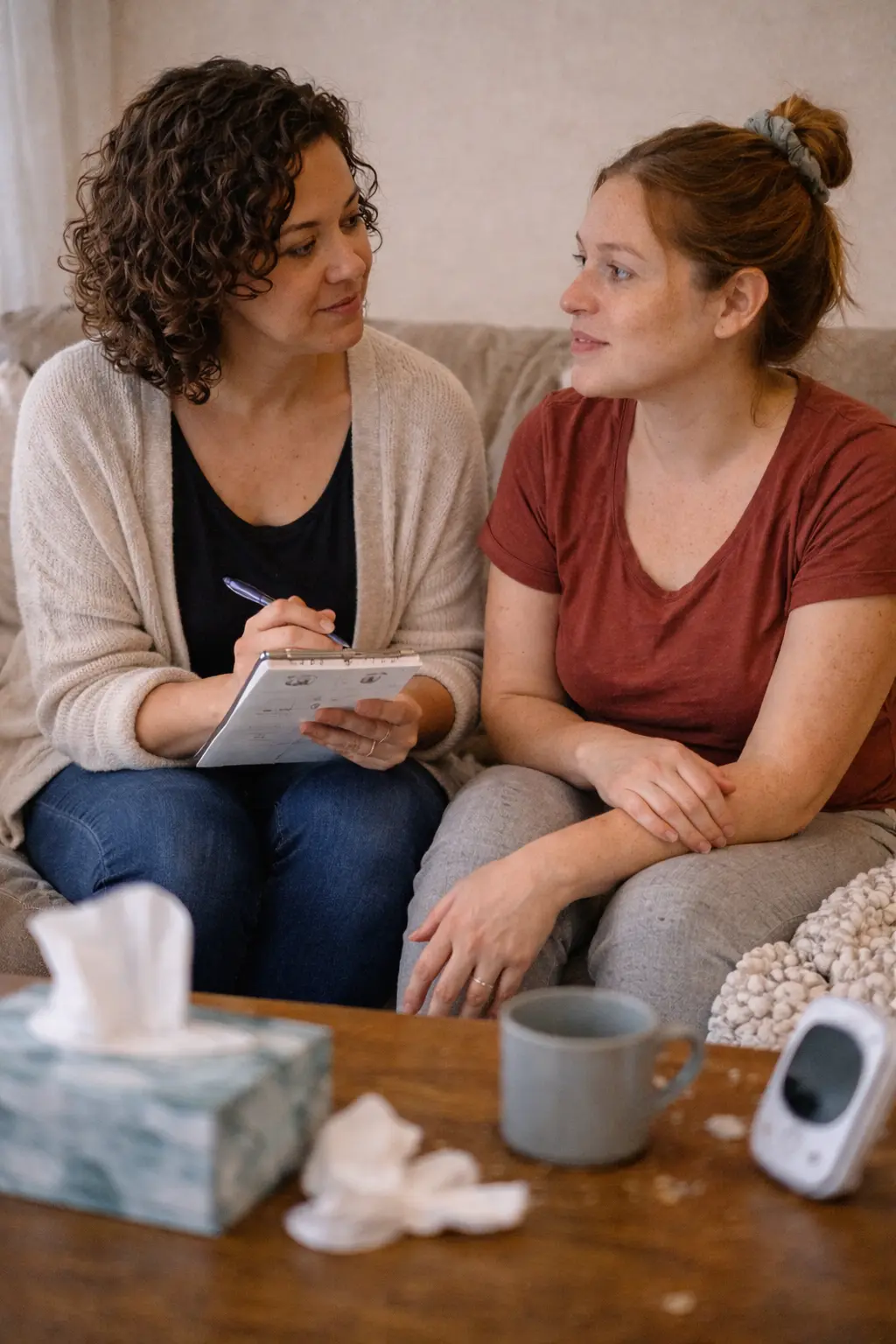
A postpartum doula is someone who comes to your home and helps you through the weeks after your baby arrives. Not a medical provider — more like someone who's been through it, knows what works, and can show you the ropes while making sure you're eating, sleeping, and not losing your mind.
Here's what that looks like in practice:
- Feeding support — breast, bottle, or combo. I help you troubleshoot latch issues, build a pumping schedule if you need one, and make sure your baby is actually getting enough.
- Sleep guidance — not sleep training a newborn (that doesn't work), but helping you build rhythms that get you more rest.
- Baby care — diaper changes, bath time, swaddling, figuring out why your baby won't stop crying at 2 AM.
- Recovery check-ins — making sure you're healing, eating, drinking water, and not falling through the cracks.
- Sibling adjustment — helping older kids cope when the new baby takes over the house.
- Emotional support — sometimes you just need someone to sit with you who gets it. No judgment, no advice you didn't ask for.
Need postpartum doula info for your city? See our local guides for Beaumont, TX and San Diego, CA for cost and availability details.
Postpartum Doula vs. Night Nurse — What's the Difference?
People ask me this all the time, and the answer matters because they're not the same thing.
A night nurse (also called a newborn care specialist) focuses on the baby. They come overnight, handle feedings and diaper changes, and keep the baby asleep so you can rest. They're baby-focused.
A postpartum doula focuses on the whole family. Yes, I help with the baby — but I'm also checking on you. How's your recovery? Are you eating? Do you need someone to talk to at 3 AM when the tears won't stop? Are you and your partner on the same page? That's the doula difference.
Some doulas (like me) offer both overnight support and daytime visits. The overnight work looks more like what a night nurse does, but I'm still keeping tabs on the parents, not just the baby.
When Should You Hire a Postpartum Doula?
Honestly? Before the baby comes. The families I work with who set things up in advance have way less stress than the ones calling me in a panic at 4 AM on day three.
But here are the signs you need one, whether you're planning ahead or already in the thick of it:
- This is your first baby and you have no idea what you're doing (nobody does — that's normal)
- You have other kids at home and need an extra set of hands
- Your partner goes back to work soon and you'll be solo during the day
- You had a tough birth — long labor, c-section, complications — and recovery is slower
- You're struggling with feeding and need in-person help
- You don't have family nearby or your family isn't helpful (we've all been there)
- You just want someone who knows what they're doing in your corner
What Overnight Postpartum Doula Support Looks Like
This is the service most people call me for, and it's the one that makes the biggest difference fast.
Here's what happens when I come overnight:
- I arrive around 9 or 10 PM and get oriented — where's the bassinet, what's the feeding plan, any concerns tonight?
- I handle all the baby care overnight — feedings, diaper changes, burping, settling back to sleep
- If you're breastfeeding, I bring the baby to you, help with positioning, and take the baby back when they're done so you can go right back to sleep
- If you're pumping or bottle-feeding, I handle everything so you can sleep straight through
- I track feeds, diapers, and anything worth noting so you have a record
- I leave in the morning with a summary and any observations I think you should know
Most of my clients go from getting 2-3 broken hours of sleep to getting 4-6 hours of actual, uninterrupted sleep. That changes everything — your mood, your milk supply, your ability to function the next day.
Daytime Postpartum Doula Support
Daytime support is different but just as valuable. During a daytime shift, I:
- Help with feeding — in-person latch support, pumping setup, bottle-feeding technique
- Take the baby for a stretch so you can shower, nap, or eat a meal without holding a baby
- Do light meal prep and make sure you're actually drinking water (you'd be surprised how many moms forget)
- Help with sibling transitions — school pickup, keeping toddlers occupied, managing the chaos
- Answer every question you have (and some you didn't know to ask)
- Watch for signs of postpartum mood disorders and connect you with resources if needed
Daytime shifts are usually 4-8 hours. Some families book me once a week, others want daily support for the first two weeks. There's no single right answer — it depends on your situation and your budget.
How Much Does a Postpartum Doula Cost?
Let's talk numbers because that's what everyone wants to know.
Overnight postpartum doula support typically runs $25–$45 per hour depending on where you live and the doula's experience. In Beaumont you're looking at the lower end of that range. In San Diego and other higher-cost areas, expect closer to the top.
Daytime support is usually in the same range, sometimes slightly less.
Most overnights are 8-10 hours, so you're looking at roughly $200–$450 per night. For daytime shifts, a 6-hour visit runs about $150–$270.
Yes, it's an investment. But compare that to the cost of a c-section recovery that drags on because you're not resting, or formula you didn't plan to use because your milk supply tanked from exhaustion, or a partner who's running on fumes and barely functioning at work. Support pays for itself.
Some insurance plans cover postpartum doula services. It's worth checking your benefits — more plans are adding this coverage than ever before. I can also provide a superbill you can submit for reimbursement. For more on payment options, see our postpartum doula cost guide.
How Long Do You Need a Postpartum Doula?
Most families book support for the first 2-4 weeks. Here's what that timeline usually looks like:
- Week 1–2: Daily or overnight support. You're in the thick of it. Feeding is still being figured out. Recovery is raw.
- Week 3–4: 2-3 overnights per week or a couple daytime visits. Things are starting to click, but you still need backup.
- Week 5–8: As-needed support. Maybe one overnight a week or a check-in call. By this point, most families feel more steady.
Some families with colicky babies or feeding struggles extend beyond that. Others only need a week. There's no wrong answer.
Finding the Right Postpartum Doula
Not every doula is the right fit for every family. Here's what I'd look for:
- Certification — PRODOULA, DONA, or CAPPA are the main ones. It's not required by law, but it means they've put in the training hours.
- Experience — ask how many families they've supported. Someone with 50+ clients has seen more situations than someone with 3.
- Overnight-specific training — if you want overnight support, make sure they've actually done it. It's different from daytime work.
- Personality fit — you're going to be vulnerable with this person at 3 AM. You need to feel comfortable with them in your home.
- Clear scope — a good doula knows what's in their lane and what's a doctor or lactation consultant's job.
If you're in Beaumont or San Diego, check out our Beaumont postpartum doula guide or San Diego postpartum doula guide for local options, pricing, and availability.
The Bottom Line
Having a baby is hard. Not "beautiful-challenge" hard — actually hard. Sleep-deprived, tear-soaked, "I don't know if I can do this" hard. Every single one of my seven babies kicked my butt in different ways, and I'm a doula. I do this for a living.
You don't get a medal for doing it alone. You get exhausted, overwhelmed, and sometimes sick. The families who ask for help recover faster, feed their babies more successfully, and honestly enjoy those early weeks more.
If you're expecting or just had a baby and you're wondering whether you need support — you do. That's not weakness. That's wisdom.
Contact me and let's figure out what kind of support makes sense for your family.
Frequently Asked Questions
What exactly does a postpartum doula do?
A postpartum doula comes to your home after birth to help with newborn care, feeding support, light meal prep, sibling transitions, and emotional recovery. She is not a medical provider. She is someone who has been through it and can guide you through the early weeks with practical help and reassurance.
When should I hire a postpartum doula?
Ideally, before your baby arrives. Families who arrange support during pregnancy have a much smoother transition than those scrambling to find help at 4 AM on day three. That said, many doulas can accommodate last-minute bookings if you are already in the thick of it.
How is a postpartum doula different from a night nurse?
A night nurse (or newborn care specialist) focuses primarily on the baby overnight. A postpartum doula supports the whole family, including checking on the mother's recovery, emotional wellbeing, and feeding journey. Postpartum doulas also work daytime shifts, which night nurses typically do not.
How much does a postpartum doula cost?
Overnight support typically runs $25 to $45 per hour, with most shifts lasting 8 to 10 hours. Daytime support is in a similar range. Most families spend $200 to $450 per overnight or $150 to $270 per daytime shift. See our postpartum doula cost guide for a full breakdown.
Does insurance cover postpartum doula services?
Some insurance plans are beginning to cover postpartum doula care, and a growing number of state Medicaid programs include it. Check with your specific plan. Your doula can also provide a superbill for you to submit for reimbursement.
Written by Shelbi Kohler