June 10, 2026
Hospital Birth Plan: What to Include
A hospital birth plan helps your care team understand your preferences for labor and delivery. Learn what to include, how to present it, and see a real example.

Let's talk about hospital birth plans — because writing one for a hospital is different from writing one for a birth center or home birth. Hospitals have standard protocols, shift changes, and busy nurses managing multiple patients. Your birth plan needs to work within that reality to be effective.
A hospital birth plan is a one-page document that communicates your preferences for labor, delivery, and postpartum care to the hospital staff who will be caring for you. It's not a contract or a demand — it's a guide that helps your nurse, doctor, and support team understand what matters most to you.
One mom from Portland, OR told me she brought a three-page birth plan to her first birth and the nurse barely looked at it. For her second, she used a single page with the essentials highlighted — and her care team actually read it. She said the difference wasn't the content, it was the format.
Why Hospital Birth Plans Are Different
A hospital is a different environment than a birth center or your home. Understanding what makes hospital birth planning unique will help you write a plan that actually works.
Staff rotations. Your nurse will likely change shifts during your labor. Your birth plan needs to communicate clearly to someone who hasn't met you before. The person who admits you may not be the person who delivers you.
Standard protocols. Hospitals have routine procedures — continuous fetal monitoring, IV access, restrictions on eating and drinking. Your birth plan should state where your preferences differ from these routines, phrased in a way that invites conversation rather than confrontation.
Multiple patients. Your nurse is probably managing more than one patient. A birth plan that takes 30 seconds to scan will be read. A three-page document will be skimmed or set aside.
A mom from Aurora, CO told me her birth plan worked because she'd shared it with her OB at a prenatal visit before labor started. Her provider flagged two things that the hospital didn't allow, and she had time to adjust before she was in the delivery room. She said that single conversation saved her from being disappointed in the moment.
What to Include in Your Hospital Birth Plan
Every hospital birth plan should cover these sections. Keep each section to 1-3 bullet points.
Your Information
Your name, due date, provider name, hospital name, and any allergies. This helps the intake nurse quickly match your plan to your chart.
Support Team
Who's with you: partner, doula, family members. Include their names so the nursing staff knows who to address.
Labor Preferences
- I want to move freely during early labor — walking, rocking, using a birth ball
- I prefer intermittent fetal monitoring so I can stay mobile, unless continuous monitoring becomes medically necessary
- Please allow clear liquids during early labor
Pain Management
- I plan to use non-medical comfort measures (breathing, position changes, hydrotherapy if available)
- I'm open to an epidural if I need it — please don't offer, I'll ask
- I'd like to try the tub or shower for pain management if available
Interventions
- Please explain any recommended intervention before starting it, including risks and benefits of both proceeding and waiting
- I prefer to avoid routine Pitocin augmentation unless medically necessary
- I'd like a heplock (saline lock) rather than a continuous IV, if possible
Delivery
- I want delayed cord clamping (at least 60 seconds)
- I want immediate skin-to-skin contact after birth
- My partner or doula should stay with me at all times
Newborn Care
- I plan to breastfeed — please don't offer formula or pacifiers without discussing with me first
- I want baby to room in with me unless medically necessary
- Please delay routine newborn procedures (weighing, bathing, eye ointment) for at least the first hour to allow bonding
If Plans Change
- If a C-section becomes necessary, I want my partner in the OR, a clear drape if possible, and skin-to-skin in recovery
- Please explain all options and let me participate in decisions
How to Present Your Birth Plan at a Hospital
How you present your birth plan matters as much as what's in it. Here's what I've learned from hundreds of families who've walked through those hospital doors.
Share it early. Give your birth plan to your provider at a prenatal visit — around 34 to 36 weeks. Don't wait until you're in labor. Your provider can flag anything that won't work at their hospital before you're in the delivery room. This is the single most important thing you can do to make your plan effective.
Bring printed copies. Bring at least three — one for your chart, one for your L&D nurse, one for your partner or doula. Digital copies are great backup, but paper travels better in a hospital. Put a copy in your hospital bag now, not when you're packing during early labor.
Hand it to your nurse at admission. Say something like, "Here's my birth plan — I've already shared it with my provider. The highlighted items are what matter most to me." This frames it as a collaborative tool, not a set of demands.
Know your top three. If your birth plan gets lost in the chaos, your care team will remember what was highlighted. Pick the three things that matter most and make them bold. For most families, those are: who's in the room, pain management preferences, and delayed cord clamping or skin-to-skin.
What Hospitals Actually Think About Birth Plans
After working with dozens of L&D nurses and providers, here's what I've learned about how hospital staff actually view birth plans:
Nurses want to know what matters to you. A good birth plan helps them advocate for you during shift changes. When a nurse reads your plan before her shift starts, she can walk into your room already knowing your preferences.
Doctors and midwives want to know your priorities. They're making medical decisions and need to know where you have strong preferences versus nice-to-haves. A clear, respectful birth plan helps them understand what they need to fight for on your behalf.
Hospital policies are real, not personal. If a hospital doesn't allow something (like waterbirth in a standard L&D room), it's not because your nurse doesn't want to support you. It's a policy decision based on their equipment, staffing, and liability coverage. A good birth plan can work around these limitations.
I'll never forget what one Houston L&D nurse told me: "Honestly, the best birth plans I see are the ones that make me feel like I'm on the same team as the mom. When a plan starts with 'I want' demands, I brace myself. When it starts with 'I'd like to discuss' preferences, I want to help."
Frequently Asked Questions
Do hospitals let you have a doula?
Yes. Most hospitals welcome doulas and many now have doula programs or referral lists. Doulas are not medical providers, so you don't need hospital approval — you can bring your doula as your support person. If a hospital tries to restrict doula access during COVID or other outbreaks, check their current visitor policy before labor.
Should I share my birth plan with my doctor before labor?
Yes. Bring it to a prenatal appointment around 34 to 36 weeks. Your provider can tell you what's realistic at their hospital and you can adjust before labor. This is the most effective thing you can do to make your birth plan work.
Can I use a doula in a hospital setting?
Absolutely. Doulas work alongside hospital staff. Many L&D nurses appreciate having a doula present because the doula handles the continuous emotional support while the nurse manages the clinical care. If you don't have one yet, our guide to finding a doula can help you start the search, or you can look for birth support in Austin, TX if you're in that area.
What if my labor happens during a shift change?
Your birth plan carries over between shifts. Hand a copy to your new nurse when she introduces herself. If your partner or doula is awake, they can also summarize your preferences. This is another reason to keep your plan to one page — it's easy to pass along.
Should I include my preferences for a C-section in my hospital birth plan?
Yes. Even if you're planning a vaginal birth, include a brief section for "if plans change." A C-section can become necessary unexpectedly, and having preferences written down — like partner in the OR and skin-to-skin — makes it more likely to happen. See our birth plan examples for a C-section plan template.
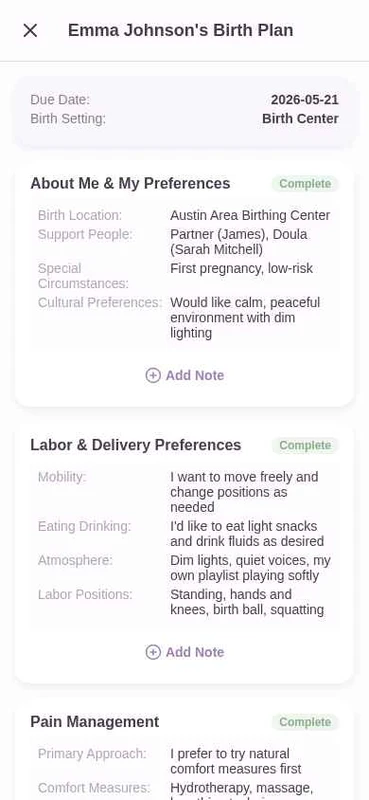
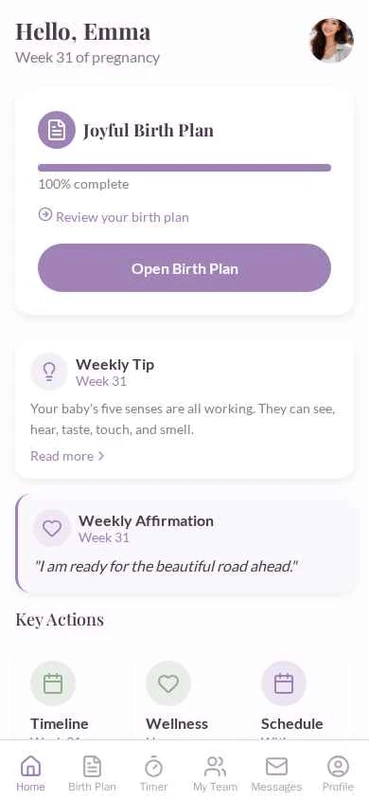
When you're ready to build your birth plan, the Joyful Birth Plan walks you through every section step by step — designed to work in a hospital setting. You shouldn't have to figure this out alone.
For more birth plan examples, check our full collection of birth plan examples for VBAC, C-section, natural birth, and more.
Written by Shelbi Kohler