July 5, 2026
Your Induction Birth Plan: What to Expect
Writing an induction birth plan? Here's what to include, what to expect with Pitocin, and how to prepare for a labor induction that stays yours.

An induction birth plan is not just a regular birth plan with "induction" written at the top. When your care team starts labor for you instead of waiting for your body to do it on its own, the experience changes in ways that matter. After seven births of my own and hundreds more as a certified doula, I can tell you that families who write a dedicated induction birth plan walk into the hospital prepared, not blindsided.
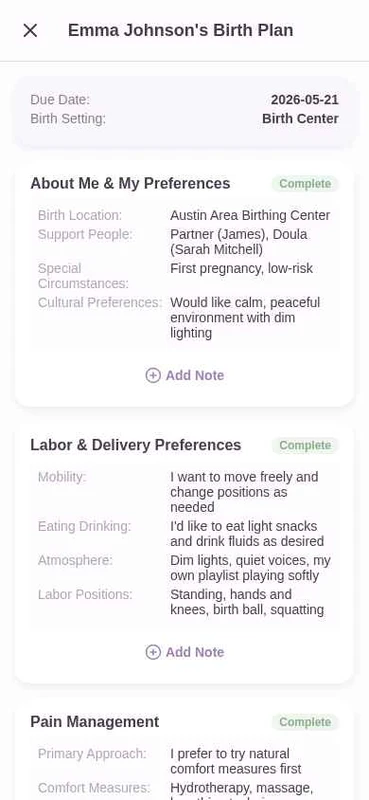
If you want a structured starting point, grab the True Joy Birthing birth plan template. It includes an induction-specific section you can hand to your nurse at intake.
What Is an Induction Birth Plan and Why Does It Need Its Own Plan?
A labor induction changes your timeline, your options, and how your contractions feel. Pitocin, the most common induction medication, brings on contractions that often peak faster and come closer together than spontaneous labor. You will likely be on continuous fetal monitoring, which limits movement. An IV is standard. Your early phase may last hours longer than you expected, especially if your cervix is not yet ready.
None of this means induction is a bad experience. It means your birth plan needs to be more specific, because the default settings are more of everything. A generic plan does not account for those. An induction birth plan does.
I worked with a mom in Aurora who was induced at 39 weeks for gestational hypertension. She had originally written a plan for spontaneous labor. When we rewrote it for the induction, she told me she finally understood what was about to happen. The unknowns became knowns.
How Do You Prepare for a Pitocin Birth Plan?
Pitocin is synthetic oxytocin, given through an IV. Your nurse starts at a low dose and gradually increases it until your contractions are regular and strong. Because Pitocin contractions can feel more intense than spontaneous ones, your pain management preferences need to be written clearly and flexibly.
If you want to try unmedicated labor, say so. But also say what you want if labor becomes more than you expected. I tell my clients to use flexibility language: "for as long as I am comfortable" and "if I request" rather than rigid declarations. Your plan should bend without breaking.
One mother I supported in Seattle planned an unmedicated induction. She wrote that she wanted to try contractions without pain medication for as long as she felt able, and if she asked for an epidural she wanted it offered within 30 minutes. Her induction took 16 hours. She got the epidural at 5 cm. Having both options written down removed the pressure to be "perfect" and let her listen to her body.
Include in your Pitocin birth plan:
- Whether you want to try unmedicated labor, and for how long
- At what dilation or intensity you want an epidural offered
- Whether you want pain medication offered without asking, or only if you request it
- Whether you want an epidural placed early in case a cesarean becomes necessary
- Any medications you are sensitive to or want to avoid
What Should You Include in Your Planned Induction Preferences?
Your planned induction preferences cover the method your provider uses and how you want to be informed at each step. This is the core of your induction birth plan.
Ask your provider which induction method they plan to use and why. The most common are Pitocin through an IV, a Foley bulb that physically opens your cervix, Cytotec (misoprostol) to ripen the cervix, and artificial rupture of membranes. Each works differently, and your plan should document which ones you consent to and in what order.
Include:
- Your Bishop score, if you know it, so every nurse who walks in understands your starting point
- Which induction method your provider plans to use
- Your preference for cervical ripening before Pitocin if your Bishop score is low
- Whether you want to be informed at each step of the process
- Your consent or refusal for specific methods, including any you want to avoid
- Your preference for eating and drinking during the early phase, if your hospital allows it
If you are planning a VBAC and facing an induction, confirm your provider is not using Cytotec, which carries a rupture risk. Read our VBAC birth plan guide for more.
How Long Does Labor Induction Take and What to Expect?
One of the most common questions I hear is, how long will this take? The honest answer is that it varies widely. Some inductions move from start to delivery in 6 to 8 hours. Others take 24 to 36 hours, especially if your cervix is not yet favorable. Knowing the general timeline helps you prepare mentally.
A typical induction follows this arc:
- Arrival and intake, 1 to 2 hours. Check in, IV placed, nurse confirms Bishop score, baby's position, and the plan.
- Cervical ripening, 2 to 12 hours. If your Bishop score is low, you may start with Cytotec or a Foley bulb to soften your cervix before Pitocin. You may be able to eat, walk, and rest.
- Pitocin start, about 30 minutes to ramp up. Your nurse gradually increases the dose until contractions are regular and strong.
- Active labor, typically 4 to 12 hours. Contractions intensify and your pain management choices kick in.
- Pushing and delivery, 30 minutes to 3 hours.
I supported a family in Chicago whose induction took 28 hours. They had packed for a long stay: books, downloaded shows, a 10-foot phone charger, snacks the hospital allowed during early labor, and comfortable clothes. Those small comforts made the waiting hours bearable. Pack like you are going on a very long, very important trip. For state-level resources, see our birth support across Illinois hub.
How Do You Handle Pain Management During an Induction?
Pitocin contractions feel different from spontaneous labor contractions. They often peak faster, feel more intense, and come with less break in between. That does not mean you cannot have an unmedicated induction. It means your pain management plan needs to account for both possibilities.
Most hospitals require continuous fetal monitoring during Pitocin. Your birth plan cannot override that, but you can ask for the most freedom within the policy. Ask about wireless telemetry monitors, which let you walk, sit on a birth ball, or use the bathroom without being tethered to a bed.
A mom I supported in Austin wanted to move during her induction. Her hospital had wireless telemetry monitors. She spent much of early labor on a birth ball next to the bed, swaying through contractions. She told me being able to move, even with the monitor on, made the Pitocin contractions feel manageable. If you are outside Austin, find providers through our Texas birth support directory.
Include in your pain management section:
- Your preference for unmedicated labor, with flexibility language
- When you want an epidural offered, if at all
- Whether you want a wireless telemetry monitor if your hospital has one
- Your preference for movement as much as monitoring allows
- Whether you want a birth ball, standing positions, or other comfort measures
What Should You Discuss With Your Provider Before Your Induction?
Your scheduling appointment is where you get the information you need to write a realistic induction birth plan. Bring questions and write down the answers. I give my clients this list:
- What is my Bishop score, and do you recommend cervical ripening before Pitocin?
- Which induction method do you plan to use, and why that one for my situation?
- Can I eat or drink during the early phase of induction?
- What monitoring will I need, and does this hospital have wireless telemetry monitors?
- How long will you let the induction go before we reassess or consider a different approach?
- What is the cesarean rate for induction at this hospital, particularly for first-time moms?
- What happens if the first induction method does not work? What is the backup plan?
- What are the hospital's policies on delayed cord clamping and skin-to-skin after an induction?
Write the answers in your birth plan so you remember them when you arrive. If you are still deciding what to include, read our guide to what to include in a birth plan. For real-world examples, our birth plan examples walk through different scenarios.
What Happens If Your Induction Does Not Work?
Failed induction is one of the most common reasons for a cesarean. I am not telling you this to scare you, but so you can plan for the possibility and make decisions ahead of time, when you are rested and thinking clearly.
Your induction birth plan should include what you want if labor stalls. Write down whether you want to be informed of risks and benefits before any new intervention, whether you want time to discuss with your partner, and what you want if a cesarean becomes necessary.
One mother I supported in Austin had a 22-hour induction that stalled at 7 cm. Her plan said that if a cesarean became necessary, she wanted her partner present and a clear explanation before consent. She also wanted skin-to-skin in the OR if her baby was stable. That is what happened. Having those preferences written down meant she did not have to make every decision in the moment.
If you want to prepare for that possibility, read our C-section birth plan guide.
Who Should Support You During an Induction?
Inductions are long. Your support person is your advocate when you are too tired to speak up. Share your birth plan with them ahead of time so they know your preferences for pain management, monitoring, and what happens if things change.
If you have a doula, they will handle much of this naturally. A doula provides physical comfort, emotional support, and helps your partner participate. If you are looking for one, start with our guide to what a doula does and our doula interview questions.
If your support person is your partner and they have never been in a hospital birth, talk through these roles ahead of time:
- Pack for a long stay. Charger, snacks, a change of clothes, something to do during the early hours.
- Know the plan. Read the birth plan together before you arrive.
- Track the timeline. Write down when Pitocin starts, when contractions pick up, when your water breaks.
- Ask questions on your behalf. If your nurse suggests a new intervention, your support person can ask about benefits, risks, and what happens if you wait.
- Take breaks. A rested support person is more useful than one who has been awake for 36 hours.
For local support, we have directories for birth support in Beaumont, Phoenix, and state-level resources for birth support across Colorado.
Frequently Asked Questions About Induction Birth Plans
Does being induced mean I will end up with a cesarean?
No. Many induced labors are vaginal. The cesarean rate is higher for inductions than for spontaneous labor, especially for first-time moms, but it is not a given. Your chances improve with a favorable cervix, good baby position, and the right induction method.
How long does an induction take?
It varies widely. Some inductions take a few hours from start to delivery. Others take 24 to 36 hours, especially if your cervix is not yet favorable. Ask your provider about your Bishop score at your scheduling appointment so you can set realistic expectations.
Can I eat during an induction?
It depends on your hospital. Some allow clear liquids and light snacks during the early phase. Others restrict food once Pitocin starts, especially if an epidural or cesarean becomes more likely. Ask at your scheduling appointment and put your preference in your birth plan.
Can I move around during an induction?
Usually yes, with some limitations. Most hospitals require continuous fetal monitoring during Pitocin, which means monitors strapped to your belly. Ask about wireless telemetry monitors, birth balls near the bed, and standing positions you can use while monitored.
What if my induction does not work?
Failed induction is one of the most common reasons for a cesarean. Your plan should include what you want if labor stalls, whether that is more time, a different method, or a conversation about cesarean. Having this documented before you are exhausted helps you stay involved in decisions.
Write Your Plan Before the Day Arrives
An induction is still your birth. You still get to plan for it, ask questions, and make choices. Write down what matters to you, talk it through with your provider, and bring it with you on the day.
If you want a place to start, use the True Joy Birthing birth plan template. It walks you through every section, including induction-specific preferences, so you walk in prepared.
You do not have to figure this out alone. Write the plan. Ask the questions. Show up ready.
Written by Shelbi Kohler