May 31, 2025
Hospital Birth Plan Template: Include
Free hospital birth plan template with every section: labor preferences, pain management, C-section backup, and newborn care. Written by a certified doula.
You're planning for a hospital birth — and you want it to feel like your birth, not just a procedure on a schedule. That's exactly what a hospital birth plan does. It gives your care team a clear picture of what matters to you before the contractions start talking louder than you can.
After supporting hundreds of hospital deliveries and birthing seven children myself, I've seen how the right birth plan turns a hospital room from a clinical space into your space. Let me walk you through exactly what to include so you walk in prepared, not overwhelmed.
What Is a Hospital Birth Plan?
A hospital birth plan is a written document that shares your preferences for labor, delivery, and postpartum care with your medical team. Think of it as your voice when you're too focused on breathing to explain yourself.
Unlike a home birth or birth center plan, a hospital birth plan works within a medical environment. That means you're planning around hospital policies, nursing shifts, and available interventions — not against them.
The best hospital birth plans are clear, concise, and collaborative. They tell your doctor and nurses what you want while leaving room for the unexpected. Your plan isn't a contract. It's a conversation starter that keeps your preferences front and center.
Why You Need a Birth Plan for the Hospital
Here's what no one tells you about hospital births: the default is their routine, not your preference. Without a plan, you get whatever that hospital does by habit — and every hospital's habits are different. If you're delivering in Austin, TX, Aurora, CO, or Portland, OR, our local city guides break down hospital-specific policies and doula support so you can plan for your exact setting.
A birth plan puts you in the conversation. It tells your team:
- "I've thought about this." You're informed and engaged, not passive.
- "These are my priorities." When your nurse has six patients, your plan helps her support what matters most to you.
- "Here's what I want if things change." A good plan includes backup preferences, so your team doesn't have to guess when the unexpected happens.
Mothers who come with a written birth plan consistently tell me they felt more respected and heard during their hospital stay. Not because the plan is a magic shield — but because it shows you've done the work and you expect to be part of the conversation.
The 7 Sections Every Hospital Birth Plan Needs
1. Labor Environment Preferences
This section covers how you want your delivery room to feel. Hospital rooms can feel sterile and bright, but you have more control than you think.
Include:
- Lighting choices (dim lights, candles if allowed, natural light)
- Music or sound preferences
- Who you want in the room — and who you don't
- Whether you want the door kept closed for privacy
- Your comfort items (your own pillow, a favorite blanket, photos)
Most hospitals allow you to adjust lighting and bring personal items. Don't assume you have to accept the fluorescent overhead. This is still your birth space.
2. Pain Management Preferences
This is often the section people focus on most — and for good reason. Being clear about your pain management wishes before labor hits hard gives you a huge advantage.
Include:
- Whether you want to try unmedicated labor, and for how long
- Your feelings about an epidural (want it ASAP, want to labor without as long as possible, or firmly want one)
- Other pain relief you'd like to try (warm compresses, birth ball, position changes, hydrotherapy if available)
- Whether you want pain medication offered to you or only if you ask
Be honest with yourself here. There's no prize for suffering, and there's no failure in choosing an epidural. Write what you actually want, not what you think you should want.
3. Delivery Preferences
This section covers what happens when it's time to push and welcome your baby.
Include:
- Position preferences for pushing (side-lying, squatting, hands and knees, semi-reclined)
- Whether you want a mirror to see the birth
- Who you want to catch the baby or announce the sex
- Whether you want immediate skin-to-skin contact
- Your preference for delayed cord clamping
- Whether you want to touch the baby's head as it crowns
Hospital policies sometimes have standard procedures for delivery. Your plan lets your team know when you want something different from their default.
4. Postpartum Care Preferences
The hour after birth matters just as much as the hours before. A lot happens quickly, and without preferences stated ahead of time, hospital routines take over.
Include:
- Skin-to-skin preferences (immediate, uninterrupted for the first hour)
- Breastfeeding plans (immediate latch, lactation consultant support, no formula supplementation unless medically necessary)
- Placenta delivery preferences (whether you want to see it, keep it, or neither)
- Perineal care preferences
- Whether you want the baby bath delayed (vernix is beneficial for newborn skin)
- Who you want present during the golden hour
5. Newborn Care Preferences
Hospital newborn care protocols vary widely. This section tells your team what you want for your baby right after birth.
Include:
- Feeding preferences (breast milk only, okay with formula supplementation, pumped milk)
- Circumcision decision (if applicable)
- Vaccination preferences (which ones, timing)
- Delayed bathing preferences
- Rooming-in preferences (baby with you at all times, or bassinet beside you)
- Whether you want all newborn procedures explained before they happen
For a comprehensive checklist covering all newborn essentials, our birth plan checklist walks you through every decision point.
6. C-Section Backup Plan
Most hospital birth plans don't include a C-section section. That's a mistake. About one in three hospital births ends in cesarean. Hoping it doesn't happen isn't a plan.
Include:
- Whether you want your partner present in the OR
- Whether you'd like a clear drape so you can see the birth
- Skin-to-skin preferences in the OR if possible
- Whether you want the same newborn care preferences applied
- Whether you want narration of what's happening during surgery
Having a C-section doesn't mean your birth plan is thrown out. It means the plan shifts — and you deserve to have your preferences honored, however your baby arrives.
7. Unexpected Situations
This is the "what if" section. It covers scenarios you hope won't happen but want prepared for — just in case.
Include:
- What you want if labor stalls (how long before interventions)
- Preferences if the baby needs NICU care (partner accompanies baby, updates to you)
- Whether you want to be informed and asked before any intervention
- Your feelings about induction augmentation if labor slows — and if you're scheduled for an induction, our induction birth plan template walks you through what changes
- Who makes decisions if you're unable to
This section isn't about expecting the worst. It's about staying in the conversation even when the unexpected happens.
What Most Hospital Birth Plans Forget
After reviewing hundreds of birth plans, here are the gaps I see most often:
Forgetting to plan for the unexpected. Many plans read like a wish list for a perfect birth. Real births aren't always perfect. A plan that only covers the ideal scenario leaves you with nothing when things shift.
Being too vague. "I prefer a natural birth" means nothing to a nurse who's heard that from every patient. "I'd like to labor without pain medication for as long as possible, and please don't offer an epidural — I'll ask if I want one" actually gives your team something to work with.
Writing a novel. Your labor nurse has maybe five minutes to read your plan. If it's three pages, she'll skim. One page with clear bullet points? She'll remember it.
Not sharing it early enough. Bring your birth plan to a prenatal appointment around 34-36 weeks so your provider can review it and flag anything that conflicts with hospital policy. Surprises on delivery day aren't fun for anyone.
Leaving out your partner's role. Your partner isn't just a spectator. Write down how they can support you — whether that's counter-pressure, reminding you of your preferences, or holding space with you.
Free Hospital Birth Plan Template
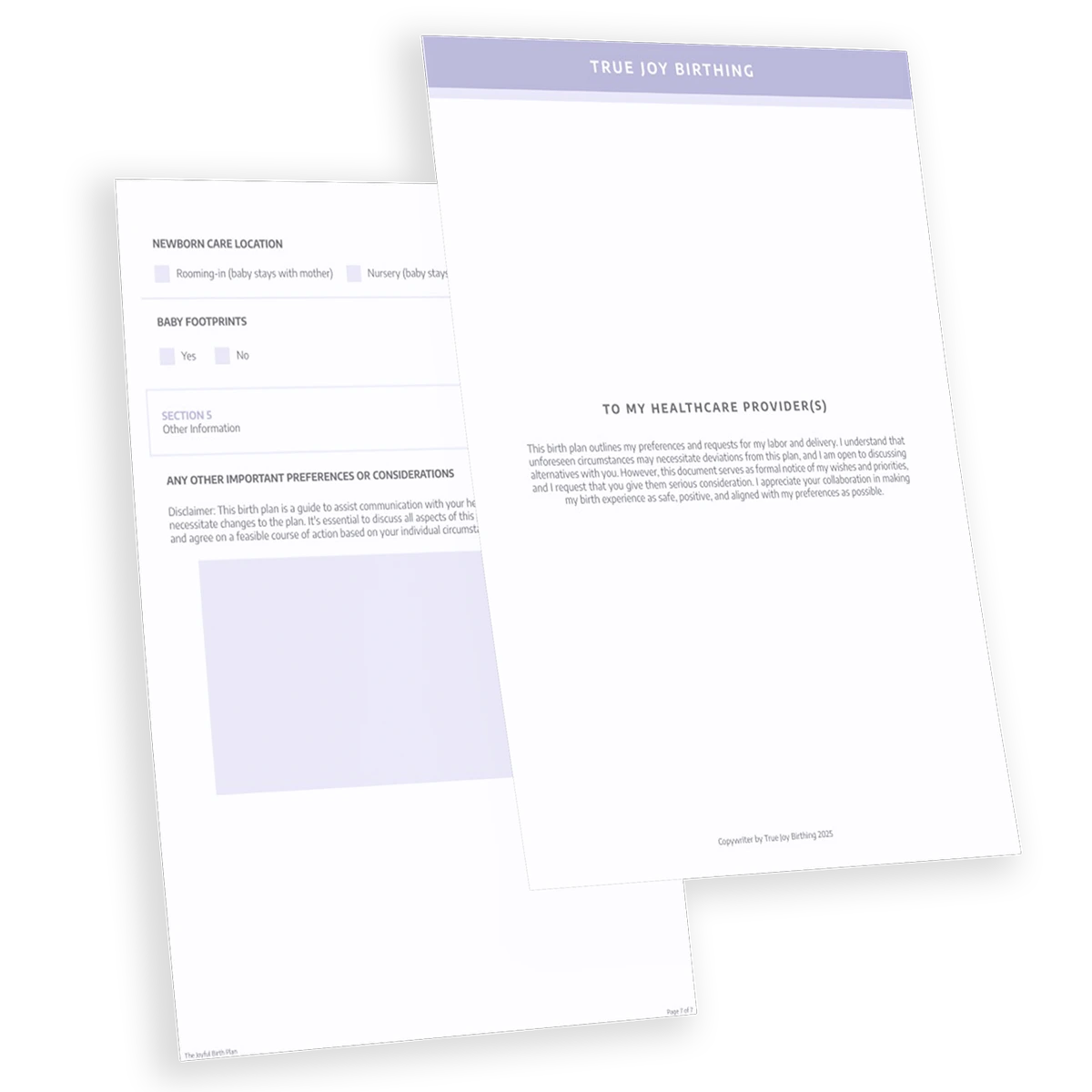
Ready to put your plan together? Our free birth plan template gives you a fill-in-the-blank format that covers every section above. Print it, customize it, and bring it to your next prenatal appointment.
For a deeper dive into hospital-specific planning, our hospital birth plan guide walks you through hospital policies, common interventions, and how to advocate for your preferences in a medical setting.
Both resources are free, written by a certified doula (that's me!), and designed to be shared with your care team.
Hospital Policies That Might Surprise You
Every hospital runs differently, and some standard policies catch families off guard. These vary by location, so knowing what's standard at your hospital helps you plan around it.
Continuous fetal monitoring. Many hospitals require continuous electronic fetal monitoring once you're admitted, even for low-risk labors. If you'd prefer intermittent monitoring, write that in your plan — and ask your provider if it's an option.
Routine IV access. Most hospitals place a hep-lock or IV line on admission. If you'd prefer to decline unless medically necessary, put that in your plan.
Eating and drinking during labor. Many hospitals restrict food and drink to clear liquids only. If that matters to you, talk to your provider ahead of time about your options.
Visitors and support people. Hospital visitor policies vary — and they can change. Confirm the current policy before delivery day, especially if you want multiple support people present.
Newborn procedures. Eye ointment, vitamin K, and first bath timing are often done by default. If you have preferences, write them down.
These policies look different depending on where you deliver. Our city guides break down local hospital details so you can plan for your specific area — check out Austin, TX, Chicago, IL, and New York, NY for hospital-specific info. You can also explore Seattle, WA for local hospital policies and doula resources in the Pacific Northwest.
Talk to Your Provider Before Delivery Day
Your birth plan works best when it's not a surprise to your care team. Schedule time with your provider around 34-36 weeks to walk through your preferences together.
This conversation does three things:
- It flags conflicts early. If your hospital has a policy that conflicts with one of your preferences, you'll know before you're in labor.
- It builds trust. Your provider sees you've done your homework and cares about being an active participant.
- It gives you alternatives. When a preference can't be accommodated, your provider can suggest options you might not have considered.
Bring a printed copy of your plan. Walk through it section by section. Ask what's realistic and what might need adjusting. Then bring several copies on delivery day — one for your chart, one for your nurse, and one for you.
You deserve a hospital birth that reflects your values and priorities. A thoughtful birth plan makes that possible. Start with our free birth plan template, make it yours, and walk into that delivery room knowing you've done the work to prepare for the day you meet your baby.
Written by Shelbi Kohler